
The popularity of open world and survival games has brought wildlife to one of the most significant parts of the game. Animations are no longer there as a background piece in a digital setting repeated in a loop. Wildlife systems have been made more dynamic in many games based on weather, sound, player actions, environmental change, and other animals. Through advances in hardware and computer simulation, a demand for realism has been developed over the years. The players want forests to be active, the predators can hunt, prey animals are wary and erratic.
The problem often is that realistic animal behaviours are complex and are hard to produce, requiring AI programming, animation systems, environmental simulation and behavioural modelling. Developers are now learning how to model accurate animal movements, predation, group behavior, real ecosystems, and generate convincing digital wildlife through the study of these behaviors.
The History of AI in Wildlife Games
In earlier video games, animals typically were just moving objects. Animations tended to be cyclical, often repeated or predictable routes and/or automated responses. An environment was created in which animals randomly walked without any meaningful interaction between the animals and between the animals and the player.
However, contemporary wildlife AI attempts to mimic more of an ecologic event than some scripted event. Animals can patrol their territory, follow migration routes, and rest at some times of the year, as well as hunt according to changing environmental conditions.
While there is no perfect simulation of an ecosystem in any game, AI developments of the last two generations make systems representing wildlife more organic and responsive in reality.
Understand Behaviour Trees and AI Systems
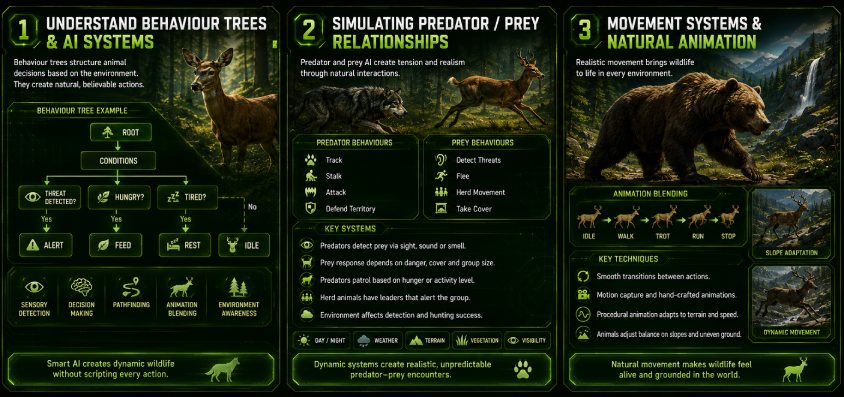
A popular system of defining animal actions is the behaviour tree. Behaviour trees can be used to structure the decision-making processes of animals in a game.
These systems logically branch actions. Depending on conditions, an animal may act to seek for food, escape dangers, or rest to save its life. The AI uses the surrounding environment to determine which behaviours to exhibit or not.
For instance, a deer will feed quietly until he hears something or sees movement nearby. Increased threat level automatically leads to an activated behaviour tree towards an alert, or escape behaviour.
Behaviour trees are useful because they enable developers to make multi-layered responses, rather than simple scripted actions. Animals seem more believable when reacting in various situations.
Blending of animations, sensory detection, and pathfinding are also usefully coupled together to produce smoother movement and interactions. It is therefore possible to provide these systems a dynamic behavior of wildlife without having to script every one of its actions individually.
Simulating Predator/Prey Relationships
Predator/prey interactions are an important part of realistic wildlife simulation. These connections are often leveraged in hunting games and survival experiences to provide environmental tension and unpredictability in the game.
Predators need to have behaviors associated with tracking, stalking, attacking and territorial defense. Prey animals require threat detection systems, movement to escape threats, and systems for moving as a group.
There are several behavioural systems that tend to influence the predator-prey interactions. Some of them are:
- Predators will detect prey in the vicinity through sight, sound or smell.
- The response of the prey animals may vary according to proximity of danger, cover or size of the group.
- Some AI systems enable the predators to keep a watchful eye on hunting territories, depending on their hunger or activity levels.
- Herd animals often have leaders that run around and alert their herd.
- Hunting efficiency and detection ranges can be affected by the environment including darkness or weather.
Movement Systems and Natural Animation
One of the most noticeable characteristics of realism in wildlife games is that of movement in animals. Even with the best underlying AI, shoddy sprites or unnatural motion can make any creation feel fake.
The blending system of animation is playing a crucial role in modern games, ensuring smoother transitions within the game’s transitions from one movement to another. Animals might move slowly from walking to running, stalking, turning or resting rather than moving from one to the next.
For larger animals, sometimes the motion capture system is employed but for larger animals manual animation is heavily used too as it may be challenging to get the movement of animals realistic.
Procedural animation techniques are also important and are being increasingly used. These systems adapt their motion to the terrain, and/or velocity, or physical interactions in a dynamic manner.
In this way, for instance, animals may also adjust their legs and spatial stability automatically when ascending mountains or hills. A large animal can also shift differently depending on the momentum and/or direction.
Movement that varies in natural ways will make wildlife seem as if they are solidly in their surroundings instead of floating above the ground.
Environmental Awareness and Reactive Behaviour
The present-day wildlife artificial intelligence (AI) systems emphasize on becoming aware of the environment more and more. Not only will the creatures act toward players but they also will respond to those around them.
Their territorial behaviour, migratory movements, sleeping habits or feeding behaviour may be affected by environmental systems. Weather systems also can impact wildlife sightings and movement.
In games, where the main factor is being stealthy or focusing on hunting, noise detection is a critical feature. Changes in the ground, actions of vehicles, gunfire or animal walking may trigger different responses from animals.
These are a few environmental reaction systems in use in wildlife themed game:
- Rains and storms can cause visibility to decrease and can affect animal behaviour patterns.
- Scent systems and tracking may be affected by wind direction.
- Predator/prey activity and vulnerability is frequently influenced by day and night cycles.
- The environment can be destroyed, this disifies wildlife from the damaged area or encourages it to leave it.
- Water bodies will often serve as concentrations for animal activity.
These details contribute to making these ecosystems seem active even when their players are not directly interacting with them.
Group Dynamics and Herd Behaviour
Many animals will work as a team instead of an individual. Inherently it poses its challenges when needing to simulate herd behaviour as the different individuals have to move and act in unison, but still look real.
Flocking algorithms are commonly employed in games for group coordination. These systems keep animals apart and aligned and help them retain directionality by avoiding unnecessary collisions.
Shared awareness systems can also form part of the capability of Herd AI. Each animal in a group reacts to a warning from another of the group. This produces more realistic fleeing action when faced with a predator or a player.
Some group behaviours are specific to different species. Herd animals are more concerned with the timing of moving in packs than determining how to move together to flee; pack predators may employ collaborative hunting strategies.
They can also enhance the realism of the environment, as wildlife populations are connected to each other by a group system, rather than being randomly distributed across the world.
Terrestrial Systems and Ecosystem Simulation
Territorial behaviour is found in some high level wildlife systems. Predators may ‘patrol’ particular areas, compete with others or protect ‘hunting grounds’ from invading others. The players might start to find out where some species are more active under different environmental factors and/or behaviour.
Modeling these behaviors simulates ecosystems that can also have an impact on spawning systems. Games can have wildlife randomly dropped across maps or strategically placed around map types, food availability, and predator presence, etc.
Some survival games have ecosystems that run on some degree of autonomy. Predators prey on the prey, scavengers prowl for carrion, and populations of animals change in time.
These kinds of systems take part in the immersion since it seems as if the world operates without the player’s immediate influence.
The Role of Hunting Games in Wildlife Realism
The rapid progress of wildlife AI has been greatly aided by hunting simulators. Hunting games depend on patience and making sure, with believable natural motions and behaviors from animals.As opposed to action-packed shooting games, hunting games rely significantly on patience, focusing on watching, and on believable natural actions and behaviors from animals.
The practitioners are usually involved in exploring true hunting strategies, the animals’ migration routes, and tracking methods. Observations need to last for long periods without being too repetitive and synthetic to be useful for wildlife systems.
In a hunting game, it is common for animals to sense a trail, turn a blind eye to any camouflage, hear sounds, and observe movements. A few titles also involve stress reactions as wounded animals change motion, try to hide, etc.
Subtleties like grazing habits, resting phases and water-related movement near bodies of water will be among the many aspects which developers will focus on, given that hunting games are concerned with realism.
Later, these sorts of systems would have an impact on open-world game design of which more game realism of wildlife was added in all genre games.
The Dynamics of Survival Games
Unlike a hunter-sims, the purposes of surviving the game are different with a survival game. Hunting games are more about watching, observing and tracking the animals whereas survival games put more emphasis on being unpredictable and on creating threats for the animals in the environment.
Predators in survival games have the potential to be more than just a bit of the environment, becoming territorial threats instead. The presence of wild animals may cause stress in the process of exploration, resource collection or moving from one place to another.
There are some survival games that depict environments with active prey species that hunt for prey. Players can see dynamic interactions that aren’t affected by scripted interactions.
Wildlife also is part of resource systems. The animals can be a source of food, material for handicraft, or a source of information concerning the proximity of dangers.
The survival elements and dynamics can be made more relevant to the player’s actions through dynamic encounters.
Finding a Balance Between Realism and Gameplay
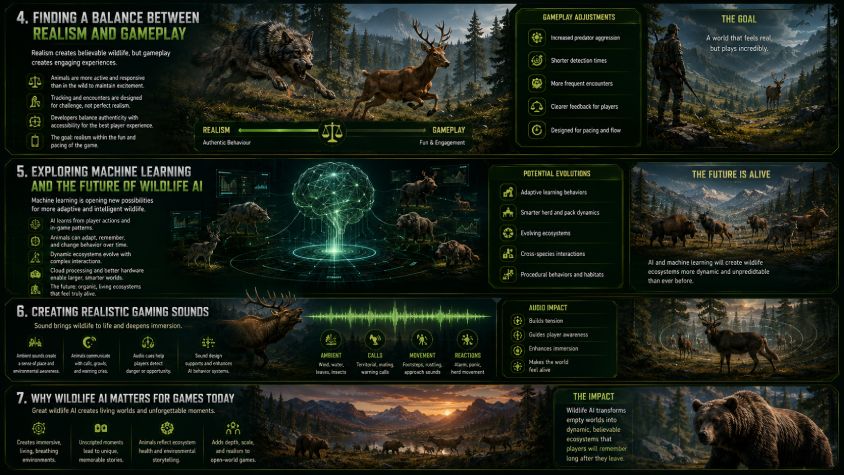
Realism is what developers are aiming for, but there is a game play element to wildlife systems as well. Just because an animal can behave realistically doesn’t mean that it will create an interesting player experience.
This means that developers often have to settle for some mix of authenticity and accessibility. The animals don’t necessarily act exactly like their real brethren, but can only act realistically within the scope of the game.
Predators may be more active in their attack than they will be in the wild. This does not necessarily make it easier to track the prey animals than on-ice tracking. These systems are modified to accommodate pacing and player engagement by the developers.
One of the biggest design problems in a wildlife theme game is striking a balance between realism and entertainment that the audience can enjoy.
Exploring How Machine Learning is Shaping the Future of Wildlife AI
AI technology is rapidly advancing and some AI developers are experimenting with machine learning technology to formulate more adaptable wildlife behaviour.
When implementing behaviour trees, the behaviour can be programmed but with machine learning systems, the AI has the potential to fine-tune behaviour through in-game patterns.
In games, this sort of large scale machine learning wildlife systems are still rather uncommon in commercial games, but the research is still making some progress in this area.
Further systems can enable animals to adapt over time or learn their surrounding environment and to form increasingly complex groups.
Increased species interactions may be made possible by larger ecosystem simulations and processing in the cloud, as well as other advancements in hardware.
These developments may ultimately create ecosystems that seem much more organic and not so man-made as the ones already in place.
Creating Realistic Gaming Sounds
Visual effects are not solely influenced by animal behaviour. A significant amount of the believability of a wild animal scene is achieved through sound design.
Here, as in all music – based art forms, the ambient nature of the systems plays a role as an expression of environmental awareness: distant movement, territorial calls, warning cries, and reactions from the environment are simulated. It is common for players to detect nearby wild animals by their noise rather than sight.
Predators can make a sound of low growl or movement sound before creating tension during the exploration phase. If threatened, herd animals may vocalize or may communicate by calling out.
The use of audio cues is also helpful to reinforce behavioural systems. Forest areas suffer from a lack of noise, which can signal incoming threats, but greater activity can mean there are fewer immediate threats.
As a result, sound design is an important add-on to the wildlife AI and not just an ambiance.
Why Does Wildlife AI Matter for Games Today?
Immersion extends past a technical realism in realistic systems of wildlife. The active, unpredictable and interwoven nature of worlds combined with believable animal behaviour.
Unscripted moments tend to be more memorable than scripted ones for players. A set piece that sees a predator or a herd reacting sharply at a turn can be memorable and make it quite special for each play-through.
Another key use case for Wildlife AI is as a tool for environmental storytelling. Animal behavior does not explicitly convey information about health-related conditions in the ecosystem, environmental threats, or activity in the world.
Wildlife systems have found greater and greater use in filling environments with dynamic frictions and activities, adding to player immersion as players increasingly encounter scale-expanding, open-world games.