
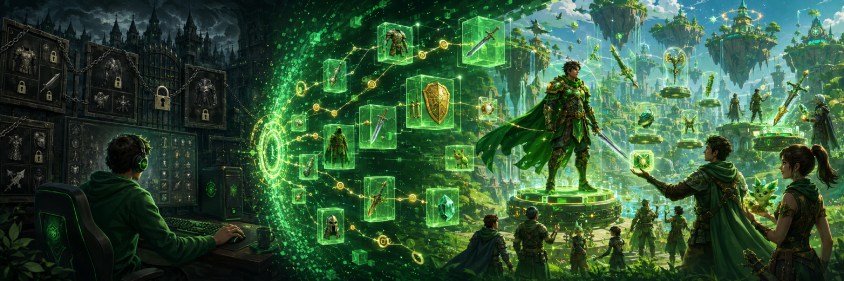
Digital ownership has become one of those ideas that sounds simple at first, but gets messy the moment you look closer. We’re used to owning physical things without thinking twice about it, but in the digital world, ownership is less obvious (especially if you’re new in this world) and often depends on the platform you’re using.
NFTs show up in gaming as a way to attach digital items to something more permanent-looking. These can be skins, weapons, characters, or collectibles, all linked to blockchain records that sit outside the game itself. Games have always been built around progression and collecting things over time.
So players spend hours building inventories, unlocking rewards, and shaping how their character looks and performs. Those same items are recorded in a different system that tracks them separately from the game world with NFTs. The gameplay stays familiar, while the things with ownership work in a different way.
What is an NFT in g?
To understand the role of NFTs in gaming, one must first look at how traditional video games handle virtual items. When you unlock a rare sword or purchase a character outfit in a standard online game, that item remains property of the game developer. It exists only on the company’s private servers. You receive a temporary license to use the item within their virtual world, but you have no control over it in the long-term.
An NFT functions as a unique, unalterable digital receipt that proves your ownership of a specific virtual asset. This receipt does not live inside the game company's database, instead, it is recorded on a decentralized network called a blockchain (which is more and more popular these days, by the way).
Because this record exists externally, the digital item gains a level of permanence. Consider physical trading cards as an analogy. If the company that manufactured your cards goes out of business, the physical cards in your possession do not vanish. You still own them, and you can still trade or sell them to other collectors.
Weapon skins in games
Cosmetics like skins, outfits, and visual upgrades are the most common use of this idea in games. They’ve grown into a huge industry where players regularly spend real money just to change how their character looks, even when it doesn’t affect gameplay at all.
It is important to note that when a cosmetic item is issued as an NFT, it receives a distinct digital serial number. Even if thousands of other players use the same character design, your specific asset has an independent identity and verifiable history.
This system makes item rarity more transparent. In many traditional games, developers can mark something as rare, but still create more copies later if they want to boost sales, which can reduce the value of existing items over time. With blockchain-based systems, the total number of items is visible to everyone. If a game states that only 100 versions of a specific golden shield exist, that limit can be checked publicly, so it’s easier to trust.
Ownership of in-game progression
This idea doesn’t just apply to cosmetic items, but also to how progress is handled inside games. In most RPGs or strategy games, everything you achieve stays tied to your account. You can invest hundreds of hours into leveling a character, unlocking skills, and climbing rankings, but all of that progress remains locked to that single profile.
Unlike with a blockchain-integrated system, where a character can be saved as an individual token. The character's level, specific characteristics, and even historical achievements are written directly into the token's metadata.
When progression can exist as a separate digital asset, it also opens up new ways for players to handle what they’ve built over time. A character that has been leveled up, equipped, and developed doesn’t necessarily need to stay with one account forever.
Some players might choose to pass it on to someone else, while others might trade it with people who prefer to skip early-game grinding and start from a more advanced point. In cases like this, the time spent building a character can end up being used in different ways outside the game itself.
Independent marketplaces in gaming
Trading valuable items in traditional games is often messy and not very safe. Most games don’t offer proper tools for secure trading outside the platform, so players sometimes turn to third-party sites to make deals. The problem is that these sites aren’t always very reliable. There’s a higher risk of scams, stolen payments, or even losing access to an account, and many of these trades also go against the game’s rules.
NFTs try to make trading safer by using open marketplaces that run on decentralized systems. Since the items exist on a shared network, players can trade directly with each other without needing a company to handle every single transaction in the middle.
- Game developers create a limited number of unique digital items and build them into the game.
- Players can get these items by completing difficult challenges or as rare drops during gameplay.
- Once obtained, the item can be listed on a digital marketplace where the player sets a selling price.
- When someone buys it, the system automatically handles the exchange, sending the payment to the seller and transferring the item to the buyer at the same time.
- A small percentage of each sale is automatically sent back to the game developers, giving them ongoing revenue from trades.
This system uses smart contracts, which are basically automated pieces of code that run on their own. Because everything is handled automatically, there’s less chance to go things wrong.
Digital card games and collectibles
Digital card games work really well with this idea. If you’ve ever collected physical cards, you probably know how it goes. You buy a pack, hope for something rare, and trade your extras with friends. Online versions usually the same, but the trading side is often much more restricted, and the collecting part isn’t as open as in real life.
Making digital cards unique works a lot more like real card collecting. You can buy the exact card you need to finish a deck, trade or sell the extras, and hold onto rare cards because they’re hard to find. And if you stop playing later, instead of just leaving it sitting in your account, you can still sell the collection.
NFT rarity and authenticity
One of the biggest advantages here is that rarity and ownership can actually be checked. In most traditional games, players just take the developer’s word for it when something is called limited. A skin might be labeled as rare, but there’s no real way to see how many copies are out there.
So with NFT systems, players can see how many of an item exist, when it was created, and how it has changed owners over time, which helps build more trust between players and developers.
Moreover, what makes it more interesting is the story behind certain items. For example a skin once used by a famous esports player or linked to a major in-game event can be very rare because of where it’s been, not just what it is. So each item ends up carrying basically a bit of history with it.
Player identity and avatar ownership
Games have become social spaces where people spend years creating how they look and how they are viewed by others. The online profile includes a username, character appearance, unlocked items and earned badges. And NFT-based systems try to make parts of that identity less tied to a single game. So some elements can exist separately and stay connected to the player across different platforms.
This can include things like:
- character appearances and skins
- rare or exclusive packages
- achievement badges or trophies
- collectible profile items
The idea is that a player’s identity doesn’t reset every time they switch games. Instead, parts of it can carry over, so progress, style, and achievements feel more consistent across different environments.
NFT inventory systems and asset management
As players collect more and more digital items, keeping everything organized starts to matter. In many modern games, a single account can end up holding hundreds or even thousands of things like collectibles, crafting materials, and event rewards.
Blockchain-based systems offer a different way to keep track of these items. Since ownership is recorded outside of the game, players can view their full collection through wallets or other tools built for managing them. It creates one clear overview of what someone owns, not just what a single game interface shows. For collectors, this can make big inventories much easier to handle. Rare skins, limited event rewards, and older collectibles can still be popular even years after they were first obtained.
Cross-game items: how realistic are they?
One of the most common ideas around blockchain gaming is that items could work across different games. The idea sounds simple, you earn a weapon in one game, then use it somewhere completely different, like a fantasy game with dragons.
It’s an appealing thought, but in practice it can be very complicated. Every game is built in its own way, so differently. They use different engines, art styles, rules, and physics systems. An item designed for a realistic shooter, for example, doesn’t easily fit into a cartoon-style platformer. The way it looks, behaves, and even the way it’s coded often doesn’t match at all.
There’s also the question of balance. A powerful weapon that works fine in one game could completely break the experience in another where combat is designed around totally different rules. Because of that, most games are built as closed systems, where items are designed specifically for that world and nobody can easily transfer elsewhere.
Realistic limits of cross-game items
In reality, sharing items across games will probably look much more limited than the big claims you often see online. Instead of moving complex weapons between completely different types of games, it’s more likely to happen within the same game universe or between closely connected titles.
- Brand ecosystems: A clothing brand could release a digital outfit that works across several games made within the same ecosystem, like a sports game, a racing game, and a social world all run by the same publisher.
- Cross-game rewards: Finishing a difficult challenge in one game could unlock a token that gives you a badge or cosmetic item in another related game.
- Franchise continuity: Certain items could carry your history with them, showing your progress or achievements as you move through sequels and spin-offs in the same series over time.
So all in all, this strategy is about maintaining a consistent player identity and brand experience. It views a player's collection as a sort of continuous profile that tracks their advancement and accomplishments in various virtual environments.
Early problems with NFT technology
Any discussion about NFTs also has to mention the problems that came with the technology in its early days. One of the biggest concerns was how much energy some blockchain networks used to operate. Many of the early blockchain networks used a system called Proof of Work. Keeping these networks running required a huge number of computers working continuously, which led to criticism over their energy consumption and environmental footprint.
Since gaming already relies on powerful hardware and large amounts of electricity, many players questioned whether adding another energy-consuming technology made sense. And the criticism was understandable, especially among communities that were already concerned about the environmental impact of gaming.
Since then, the technology has changed quite a bit. Most newer blockchain networks use different systems, for example Proof of Stake, which require far less computing power to run. This change has cut energy use a lot and eased one of the biggest concerns people had when NFTs first showed up in games.
Making blockchain features easier for players
For any new feature in games to actually be used by a lot of people, it has to feel simple. Right now, dealing with blockchain systems is still too complicated for most players who just want to open a game and enjoy it.
In practice, the process usually goes like this:
| Step | What the player has to do |
|---|---|
| Wallet setup | Install a separate crypto wallet in your browser |
| Security backup | Write down and safely store a 24-word recovery phrase |
| Funding | Create an account on an exchange and buy crypto |
| In-game actions | Approve every in-game action manually each time |
For most casual players, this feels like too much just to play a game.
Creators wanted to make things easier, so newer systems are trying to hide all of this in the background. A wallet can be created automatically when you sign up with a normal email and password, and you don’t have to setting everything up manually.
Transaction fees are either covered in the background or already included in what you pay, so players don’t really have to deal with them. In the end, it’s all so much simpler. You just play, earn items, and trade them if you feel like it.
So what digital collectibles will become?
All in all, in many games, items are being used to mark moments that matter inside the game, like live events, community goals, esports competitions, or short-term challenges. Some of these items work like souvenirs, reminders of something a player actually took part in. Others can open access to private groups, special events, or give a bit of recognition within the community.
As games continue to expand and interact with each other, these types of collectibles are likely to play a larger role in how players share their experiences. Just like how people collect rare cards or limited edition items in real life, players can create digital collections that represent their time, progress, and memories in the games they play.