
When it comes to video games, our preferences differ. And there are usually reasons behind these preferences. Some players love the excitement of quick reactions and intense battles, which is why they enjoy fast-paced shooter games. There are also sports games, racing games, strategy games, and several other kinds of games. And each of these games has its own dedicated audience.
In this article, we want to talk about hunting and survival games. These kinds of games have built a massive following over the years and are among the most-played games today. And of course, the people who play them have their reasons for doing so. But then, if you prefer a different type of game, you might not really understand the appeal that these games have to the people who play them.
Well, that is exactly what we are going to explore in this article. We will examine why hunting and survival games continue to attract players, considering two major factors: the immersive design elements and the psychological appeal that these games have. Let’s dive right in.
Immersive Design Elements That Keep Players Engaged
How a game is designed definitely affects how players will feel about the game. And this primarily has to do with the visuals, sounds, features, mechanics, interactive systems and other details that makes the game feel real to the player, even though it’s still a virtual environment.
These things differ with different games. In a football game for example, the players, stadium crowds and other elements have to look and move a certain way for players to enjoy it. The same thing applies to hunting and survival games. There are certain designs, elements and features that draw players in.
Let’s take a look at some of these in-game elements and design features:
Open-World Exploration
One of the most defining features of many hunting and survival games is the freedom they give players to explore. These games often place players in large open worlds and allow them to decide how they want to approach the experience. They can choose where to travel, which areas to investigate, and what activities to prioritize.
And as a result, different players might end up focusing on different things. Some may focus on hunting and gathering resources, while others spend their time building shelters or exploring distant locations. This non-linear approach allows players to create their own stories and experiences. It makes them feel as though they are shaping their own journey, which makes the experience far more engaging.
Wildlife AI
Hunting would quickly become repetitive if animals behaved the same way every time. To prevent this, many hunting and survival games use advanced wildlife AI systems that allow animals to behave in more realistic and unpredictable ways.
That is, the in-game animals would actually display realistic movement patterns, migrate between different areas, or even react differently depending on the time of day and environmental conditions. They can also respond to player actions. For example, loud noises or sudden movement may cause an animal to flee.
All these realistic elements make the game feel like a genuine challenge. For example, players must study animal behavior and plan their approach carefully, just like they would need to do in a real-life hunting situation.
Wildlife Tracking Mechanics
Wildlife tracking mechanics add another layer of depth to the experience in hunting games, because it encourages players to pay closer attention to their surroundings. Tracking systems often include footprints, trails, feeding areas, broken vegetation, and other signs that indicate an animal’s presence. And players must observe these clues and use them to determine where their target might be heading.
Apart from the fact that it makes the whole game feel more real, the fact that it also now requires players to use these features and clues strategically makes the game feel even more engaging. For example, a player would need to slow down, study the landscape, and think strategically while tracking. And that’s usually a very enjoyable aspect of the game.
Environmental Storytelling
Environmental storytelling is a game design technique where the in-game world itself tells a story without directly explaining it through dialogue, cutscenes, or written narration. This is another design element that helps keep players engaged in hunting and survival games.
For example, while playing, players may come across an abandoned campsite, ruined buildings, damaged equipment, in the game. These details can hint at some past events and encourage players to piece together what happened on their own. This makes the game even more intriguing because there is always the possibility of uncovering something interesting. It also adds more elements of realism to make the game feel richer and more believable.
Dynamic Weather and Day-Night Systems
Dynamic weather and changing day-night cycles are other elements that add more realism and unpredictability to hunting and survival games. The idea here is to have players also experience real-life weather conditions and its effects in the game. For example, weather conditions such as rain, fog, snow, or storms may reduce visibility, affect movement, or make certain tasks more difficult. It would also affect other in-game elements and characters like the animals who might behave differently depending on the time of day. And some species may be more active at dawn or dusk, while others may emerge primarily at night.
And because the weather conditions are changing, players must adapt their playing strategies accordingly. So if a plan that worked during clear daytime weather, it may not be effective during a stormy night. This variety also helps to make sure that the gameplay does not feel repetitive, but instead keeps players engaged and thinking about their next move.
Realistic Ecosystems
Apart from making the game appear very real in terms of the visuals, one other aspect that draws players in is how these in-game elements interact with each other. Players want to see them mirror real-life interactions. For example, in a hunting game, you may get to see predators hunt prey, animals compete for resources, and certain species appear in specific habitats. Resource availability can also change depending on environmental conditions or player actions.
Apart from the realism, these interconnected systems also help create the impression that the world exists independently of the player. That is, rather than feeling like everything revolves around the player’s presence, the environment feels alive and active on its own. This greatly enhances immersion and encourages players to spend more time exploring and interacting with the in-game world.
Audio Design
Sound design also plays an equally important role in creating immersive experiences for players of these games. Well-designed audio helps players feel connected to the environment and can even influence their survival decisions.
For example, the sounds of rustling leaves, distant animal calls, flowing water, wind moving through trees, or footsteps approaching from behind all contribute to the atmosphere. These sounds make the environment feel more realistic and believable.
In many situations, audio also serves as a practical gameplay tool. Players may use sounds to locate wildlife, identify potential threats, or determine changes in weather conditions. In other words, sound is not just there to create atmosphere; it often becomes an important part of the survival experience itself.
Cooperative Multiplayer Exploration
Some hunting and survival games have also introduced cooperative multiplayer features. And to a large extent, it’s gotten players more hooked to these games. This is because exploring and surviving alongside other players introduces a social element that can make the experience even more enjoyable. Players can get to work together, which can also make the tasks that might be difficult for a single player become more manageable.
The Psychological Appeal of Hunting and Survival Games
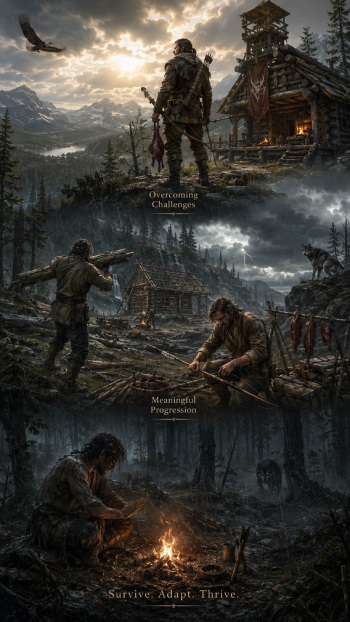
Games become popular not just because of what they allow players to do, but because of how those experiences make players feel. That is, there are psychological aspects to the interest that players have in different games. Hunting and survival games also tap into several powerful psychological drivers, and they help increase engagement, which keeps players invested for long periods. Let’s take a closer look at some of these key psychological factors:
The Desire for Meaningful Progression
One of the biggest attractions of hunting and survival games is the sense of progression they provide. Unlike many games that equip players with powerful weapons, abilities, or resources from the very beginning, survival games often start players with almost nothing.
You might begin with only basic tools, minimal supplies, or no shelter at all. From there, every step forward is something you have to work for. You gather resources, craft equipment, improve your shelter, and gradually become better prepared to survive the challenges around you.
Because of this, every achievement a player makes feels meaningful. If you get a new weapon, for example, it doesn’t just feel like another item added to your inventory. It feels like a deserving result of the time, effort, and planning you put into the game.
The Satisfaction of Overcoming Challenges and Surviving
In hunting and survival games, staying alive is usually a major task. Players often have to manage hunger, thirst, weather conditions, dangerous wildlife, and limited resources. And they’re designed in such a way that every decision a player makes in the game carries some level of consequence. For example, a player might be in a position to decide whether to spend their remaining supplies now or save them for later. Or whether to venture into a dangerous area in search of valuable resources, or play it safe and risk falling behind.
These choices create a level of tension that keeps players engaged, because in a way, there is always something to think about, plan for, or overcome. More importantly, the consequences that come with failing, maybe losing resources, getting caught unprepared during a storm, or failing to secure enough food, also add a kind of thrill.
And success in these games feels genuinely rewarding, given that the players have had to go through difficult situations and major obstacles. It provides a sense of accomplishment that many players find deeply satisfying.
Freedom to Create Personal Experiences
Hunting and survival games give players a great deal of freedom. These games often allow players to approach challenges in their own way. Some players may focus heavily on exploration, spending hours discovering new areas and uncovering hidden resources. Others may prioritize hunting, becoming experts at tracking animals, and gathering food.
This freedom also means that no two players experience the game in exactly the same way. Even within the same game, different decisions can lead to entirely different outcomes and stories.
That ability to shape one’s own journey is a major reason why many players love these hunting and survival games. It’s like the players are not just following a predetermined experience; they are creating their own.
The Thrill of Uncertainty and Risk
As already mentioned, in many of these games, no two playing sessions usually pan out exactly the same way. The decisions that players make usually shape their experiences. And each playing or decision path is filled with unexpected events that can quickly alter a player’s plans.
This unpredictability creates tension and excitement. Since there is always an element of risk, players remain alert and invested in what happens next. And when they overcome difficult situations despite the uncertainty, they often experience a stronger sense of satisfaction than they would in a more predictable game environment.
The Appeal of Exploration and Discovery
Humans are naturally curious, and hunting and survival games often take advantage of that curiosity. These games frequently place players in large, open environments filled with forests, mountains, rivers, caves, and other locations waiting to be explored. For many players, the desire to discover what lies beyond the next hill or inside a hidden cave is a powerful motivation.
The Connection to Primal Survival Instincts
At a deeper level, hunting and survival games appeal to activities that have been central to human existence for thousands of years. Long before modern society existed, humans depended on hunting, gathering resources, finding shelter, and protecting themselves from threats in order to survive.
Although players are experiencing these activities in a virtual environment, the basic concepts remain familiar. Gathering food, crafting tools, building shelter, and defending territory all reflect challenges that were once essential to human survival. These activities create a sense of purpose because they revolve around goals that are easy to understand and naturally meaningful.
Popular Hunting and Survival Games to Try Out
If all this discussion about hunting and survival games has sparked your interest, you might be wondering where to start. Below are some of the most popular hunting and survival games worth trying:
- Monster Hunter Wilds: Monster Hunter Wilds is an action-focused hunting game where players track and battle massive monsters across vast environments. The game’s dynamic weather systems and changing ecosystems constantly influence the monster’s behavior and combat encounters with them.
- Way of the Hunter 2: Way of the Hunter 2 is a highly realistic hunting simulator set in the Canadian wilderness. Players must carefully track wildlife, manage factors such as scent and wind direction, and use realistic hunting tools. The game also features advanced blood-tracking systems and long-term ecosystem management mechanics.
- The Long Dark: The Long Dark is a survival-focused game set in a frozen post-apocalyptic wilderness. With no monsters or supernatural threats, players must survive against hunger, exhaustion, harsh weather, and dangerous wildlife.
- Sons of the Forest: Sons of the Forest combines survival gameplay with horror elements. Players gather resources, build shelters, and hunt for food while trying to survive on an island inhabited by intelligent cannibal tribes and terrifying mutants.
- Soulmask: Soulmask is an open-world survival game centered around tribal management and exploration. Players build settlements, recruit tribe members, automate tasks, and progress through a large technology tree. Its unique mask possession mechanic allows players to take direct control of different tribe members with specialized skills.
Challenge, Discovery, and the Enduring Pull of Survival Games
Players who enjoy hunting and survival games are often drawn to them because of the way these games are designed. Features such as expansive open worlds, realistic wildlife behavior, dynamic weather systems, environmental storytelling, immersive audio, and living ecosystems work together to create experiences that feel believable and engaging.
However, the appeal goes beyond the design elements alone. There is also a strong psychological component behind the genre’s popularity. Hunting and survival games have a unique way of making players feel challenged, resourceful, and accomplished. They reward patience, planning, adaptability, and perseverance, while also satisfying the natural desire for exploration, discovery, and progression.
The combination of these immersive design elements and psychological rewards comes together and creates engaging and memorable experiences for players. That is why, despite the constant release of new gaming genres and trends, hunting and survival games continue to attract players and remain popular.