
There’s an excitement that comes with playing a new game. However, after playing for some time, that initial excitement begins to wear off, and you start losing interest.
Some games, however, somehow manage to get players still interested and excited even after months of playing. One major characteristic of these kinds of games is progression. These games are designed to give players that feeling of making progress, which often motivates them to come back and keep playing.
To really understand this concept very well, let’s take a look at what exactly progression means and what makes a game progression-based. We will also examine in detail what exactly makes progression-based games attractive to players. Let’s dive right in!
What is Progression in Gaming and What Makes a Game Progression-Based?
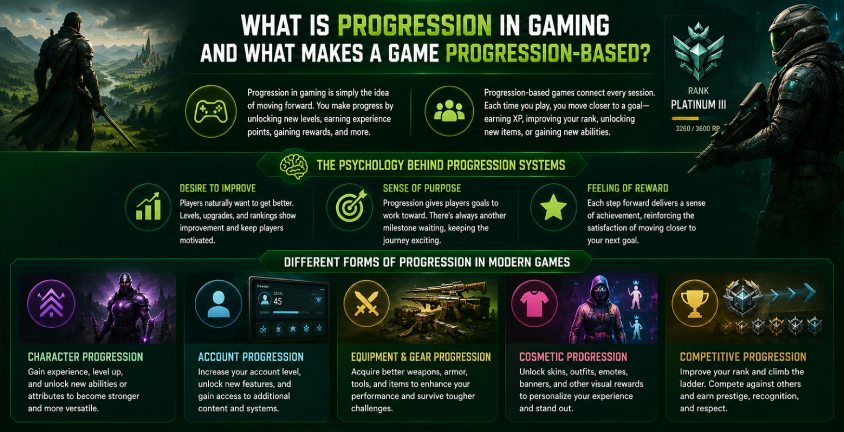
Progression in gaming is simply the idea of moving forward. When you’re playing a game, you move forward by unlocking new levels, earning experience points, gaining rewards, etc. That’s progress in gaming.
Not every game is designed like that. For example, a traditional game of chess does not have a progression system. You play a match, it ends, and the next match starts with both players on equal footing. It’s designed to be played in short sessions where players jump in, play, and leave. And whatever they play in a match does not carry much over to the next match.
Progression-based games, however, are different. Every gaming session you have is connected, and every time you play, you are making progress towards a goal. You may be earning experience points, increasing your ranking, or unlocking a new weapon.
The Psychology Behind Progression Systems
Now, before we go into the different forms, features, and progression concepts that game developers use to attract players to progression-based games, it’s important to note that this progression idea has a psychology behind it. And it is on the basis of that psychology that features and concepts stand.
Now, one reason why progression-based games keep getting players back playing is that these games appeal to the human natural desire to improve. Just like you would want to improve in real life, as a player, you also want to improve in the game you are playing. The things that show your improvements are the levels you unlock, weapons you upgrade, rankings you attain, and so on.
That is how progression-based games support this desire. You start at level one and can eventually reach level fifty. You start with a basic character and can gradually gain new abilities, equipment, and skills. Each step forward reinforces the feeling that improvement is happening.
Progression-based games also appeal to the human natural sense of purpose. That is, it gives the player a reason to keep playing. They want to reach a new level, they want to unlock a new weapon, and so on. A good progression system always ensures that there is always another goal waiting after the previous one is completed. That way, there’s always a goal, a pursuit, a purpose for playing the game. And that keeps the player coming back.
Different Forms of Progression in Modern Games
Modern games use progression systems in many different ways. Here are the most common categories:
- Character progression: With character progression, players gain experience, level up, and unlock new abilities or attributes that make their characters stronger or more versatile.
- Account progression: The focus here is on the player’s overall profile rather than. They increase their account level, unlock new features, and gain access to additional content.
- Equipment and gear progression: This revolves around acquiring better weapons, armor, tools, or items.
- Cosmetic progression: Cosmetic is all about appearance and personalization. Players unlock skins, outfits, emotes, banners, and other visual rewards that allow them to personalize their experience in the game.
- Competitive progression: Competitive progression is common in multiplayer games. Instead of unlocking items, players work to improve their rank within the game, climbing from lower tiers to higher tiers.
The Different Progression Features
Now, let’s look at the actual progression features that progression-based game developers incorporate in games. Each of the features falls under at least one of the different forms of progression that we have examined already. They include:
Leveling Systems and Character Growth
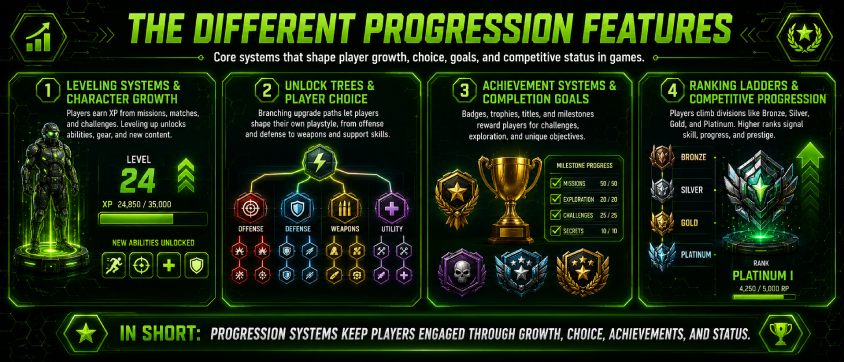
One of the most common progression systems in gaming is the leveling system. The concept is simple. Players earn experience points by completing missions, winning matches, defeating enemies, or participating in various in-game activities. As your experience accumulates, you level up and gain access to new rewards.
These rewards can unlock new abilities, skills, or perks that expand what your character can do. Some would grant you access to new content, equipment, missions, or gameplay features. In either case, leveling gives a clear reason to continue playing because there is always another level to attain.
Unlock Trees and Player Choice
Many progression-based games also use trees that allow players to decide how they want their progression journey to look. For example, as a player, you can choose between improving offensive abilities or strengthening defensive skills. Or maybe prioritize unlocking advanced weapons, while someone else focuses on support abilities or utility upgrades.
This level of choice makes the game feel more personal because instead of just receiving rewards in a fixed order, you are actively participating in shaping your own growth. The progression system, in a way, becomes an extension of your playstyle.
Achievement Systems and Completion Goals
Achievement systems reward players when they complete specific objectives, reach a milestone, or perform a unique task within a game. These rewards may come in the form of badges, trophies, titles, medals, or other recognition systems.
One thing with achievement systems is that they encourage players to engage with aspects of the game that they would not usually explore. That is, other game modes. But because of the achievement attached to it, they try it out. It could require them to use unusual strategies, complete difficult challenges, or approach the game in a different way from what they are familiar with. All this further makes the overall gaming experience feel more varied and engaging.
Ranking Ladders and Competitive Progression
Many multiplayer progression-based games use tiered ranking systems that place players into divisions or ranks like Bronze, Silver, Gold, Platinum, etc. Players can then move up or down these ladders based on their performance against other players. Advancing to a higher rank shows that a player has improved and can now compete at a higher level, which is why the desire to climb the ladder to a higher level can be incredibly motivating.
Ranking systems also introduce a form of prestige to players within the game’s community. It serves as a visible indicator of skill and dedication, and it earns respect from other players.
Reward Loops: How They Keep Players Engaged in Progression-Based Games
Now, there’s a way the above progression systems are structured that makes them quite effective. One concept that is usually applied is called the reward loop. This is simply a cycle that encourages players to keep taking actions because those actions consistently lead to some form of reward. It follows this simple trajectory, which is incorporated in every effective progression-based game:
- Action
- Reward
- Motivation
- Repeat
This just means that a player completes an action. It can be completing a mission, winning a match, defeating an enemy, or finishing a challenge. The game then rewards that effort with experience points, currency, equipment, achievements, or some other form of progress. Receiving that reward feels satisfying, which motivates the player to continue playing and earn the next reward. The cycle then repeats itself.
This may seem simple, but it’s the foundation of many modern progression systems. Here are some other elements of the reward loop that make it so effective:
Frequent Rewards vs Major Milestones
One reason why reward loops work so well is that they combine both small and large rewards. Small rewards help maintain momentum. That is, a player might earn experience points after a match, a daily challenge, a minor upgrade, or after receiving in-game currency. Individually, these rewards may not seem significant, but they create a steady sense of progress. This steady stream of rewards is important because it gives players regular confirmation that they are moving forward.
At the same time, progression systems also include larger milestones. These are the rewards that require greater effort and patience. For example, reaching a new rank, unlocking a powerful ability, completing a battle pass, earning a rare cosmetic item, or achieving a major in-game milestone all take longer than just gaining an experience point. But these larger rewards serve as long-term objectives that keep players invested in the game for weeks or even months.
Both types of rewards are necessary. If a game only offers major milestones, progress may feel too slow and distant, which will cause players to lose motivation. On the other hand, if rewards are handed out too easily and too frequently, players may eventually feel that their accomplishments are not particularly meaningful. The most successful progression systems balance the two. They give players enough short-term rewards to stay engaged while also providing larger goals to strive toward.
Creating Anticipation and Excitement
Another reason reward loops are so effective is that they create anticipation. Players are not just motivated by the rewards they have already earned. They are also motivated by the rewards they know are coming. For example, if you are just one level away from unlocking a new weapon, you’ll be eager to play in order to unlock the weapon.
The way game developers strengthen this feeling is by making progress highly visible. They use progress bars, milestone trackers, challenge lists, and reward previews to show you exactly how close you are to your next objective. This visibility creates excitement because you can see the finish line approaching. And the closer you get, the stronger your desire to keep playing until you reach it.
Consistent Feedback
For reward loops to work, players also need constant feedback that their actions are making a difference. This is why successful progression systems make progress visible. They serve as a form of feedback to reassure players that every playing session is important. Even when players do not achieve a major milestone, they can still see evidence that they moved one step closer to their goal.
Seasonal Progression Systems: How They Keep Players Engaged in Progression-Based Games
Another progression system that is now used in progression-based games is the seasonal progression system. With this kind of progression system, you cannot progress through a game once and eventually run out of objectives, which is what usually happens when some players complete a game. With this system, players are given fresh progression paths every few months. And in that way, they always have new reasons to return to playing.
How Seasonal Rewards Changed Modern Gaming
One of the biggest developments in modern game design has been the rise of battle passes and seasonal content. A battle pass is essentially a progression track that players advance through by earning experience and completing challenges during a specific season. It’s similar to seasonal events, which are usually limited-time events.
Now, during these limited-time events, players are often given special challenges and unique rewards that can only be earned within a certain timeframe. Once the event ends, those opportunities may disappear until the next season, or sometimes forever. Many games also introduce limited-time progression tracks that exist alongside their permanent progression systems. These tracks provide additional objectives and rewards that encourage players to stay active throughout a season.
The interesting thing about these systems is that they give players something new to work toward on a regular basis. Even if someone has already reached a high level or maybe completed the game, a new season presents them with another progression, and they want to explore, and that, of course, gets them back to playing the game.
So, even though the experience points, levels, and so on keep players from coming back into progressive-based games, it only does that till they complete the game. Seasonal progression systems, on the other hand, encourage players to still participate consistently regardless of whether they’ve reached a high level or completed the game. And so they keep long-term players invested in the game.
How Progression Systems Strengthen Multiplayer Communities
Multiplayer games already have a natural advantage when it comes to keeping players engaged. Unlike single-player games, where interest can fade once the story or content is completed, multiplayer games constantly offer fresh experiences because players are competing or cooperating with real people. Many players return simply because their friends are online, a new team is forming, or they want to test their skills against other players.
When progression systems are added on top of that, the effect becomes even stronger. Players are no longer returning only for social interaction or competition. They are also working toward new ranks, rewards, unlocks, achievements, and milestones. Every match serves two purposes: enjoying the multiplayer experience and making progress toward a larger goal. As a result, progression gives players an extra reason to log in regularly, helping maintain long-term engagement while strengthening the game’s community.
Beyond these, progression systems also play a major role in building and sustaining multiplayer communities through:
Shared Goals That Create Active Communities
One of the ways progression systems strengthen communities is by giving players common goals to pursue. When large numbers of players are trying to unlock the same rewards, complete the same challenges, or advance through the same progression systems, conversations naturally begin to form around those experiences.
Players discuss strategies for leveling up faster. They share advice on completing difficult objectives. They create guides explaining how to unlock specific rewards or overcome particular challenges. Newer players seek help from more experienced members of the community, while veterans often enjoy sharing their knowledge.
This creates a constant flow of interaction both inside and outside the game, which creates active communities, whether on social media groups, Discord servers, etc. In many cases, this community-driven engagement becomes part of the overall experience. Players are not only progressing through the game itself; they are also participating in a larger network of people working toward similar goals.
Status, Recognition, and Social Motivation
Progression systems provide visible symbols of achievement, which most times serve as proof of a player’s dedication, skill, or experience. Specifically, rare achievements, exclusive cosmetics, prestigious titles, and high rankings allow players to showcase what they have accomplished. And this creates a form of social motivation, such that players are no longer pursuing rewards for personal satisfaction, but also for recognition from others.
Why Progress Keeps Players Coming Back
Players keep returning to progression-based games because these games provide something that many people naturally enjoy: the feeling of growth. That feeling can come in different forms. It could be by leveling up a character, unlocking a new ability, earning a rare reward, climbing a ranked ladder, completing a difficult achievement, etc. These keep players engaged.