
It would probably sound like a lie if someone told you they turned down $1.5 million in real cash for an in-game weapon skin. After all, how can a virtual item that exists only inside a video game be worth that much money?
Well, you might be surprised to learn that it actually happened. The item in question was the “Factory New” Pattern #387 Karambit Case Hardened, better known among collectors as the Blue Gem. This is widely regarded as the most valuable knife skin in Counter-Strike. And yes, if you’re not familiar with it, Counter-Strike is just a video game.
But how did we get here? How did virtual items go from being simple in-game collectibles to assets that people are willing to spend serious money on? How did in-game marketplaces evolve from just simple item shops into the massive business ecosystem they are today? Well, sit tight, keep reading, and let us take you through the journey.
What Are In-Game Marketplaces?
Before understanding how in-game marketplaces became such a massive business, it helps to first understand what they actually are and why players use them in the first place.
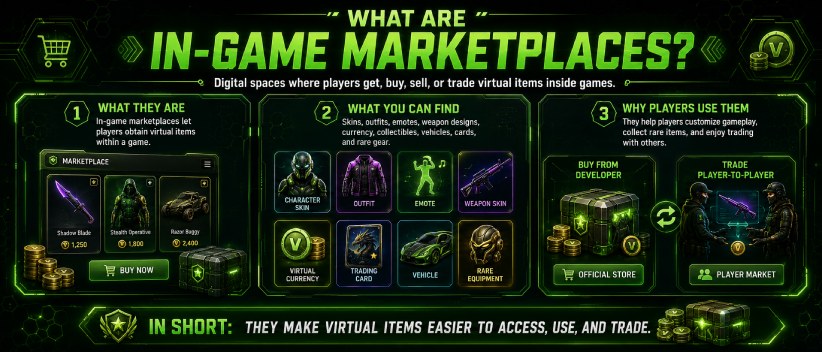
An in-game marketplace is simply a digital space within a game where players can obtain, buy, sell, or trade virtual items. These items are not physical products. They exist entirely within a game, but they often play an important role in how players experience the game.
The exact items available vary from one game to another. In some games, players can buy cosmetic items like character skins, outfits, emotes, or weapon designs. And in some other games, it could be virtual currencies, collectibles, vehicles, trading cards, or even rare pieces of equipment. Some marketplaces allow players to buy these items directly from the game developer, and some also enable player-to-player trading.
Simply put, these marketplaces are designed to give players access to items that they can use to enhance their experience or simply the overall enjoyment of the game.
How In-Game Marketplaces Differ from Traditional Game Stores
To avoid confusion in-game marketplaces with traditional game stores, let’s differentiate them. Traditional game stores are simply for buying games. You buy, download, and install the game. Period!
However, you don’t buy the game itself on an in-game marketplace. You only buy items that you can use in the game in the marketplace. You can sell and trade as well. And today, these marketplace activities have become equally important as gaming itself.
The Rise of Virtual Economies
Now, these in-game items were not worth the hundreds and thousands that we see now at the very beginning. But then, it got to a point when players buying, selling, and trading these items began to get even more mainstream attention, and then players started assigning real-world value to the items.
The harder an item was to obtain, the more valuable players often considered it. And as it went on, some players became willing to spend significant amounts of real money to acquire these items. In return, some also saw that as opportunities to trade and profit from them.
This eventually led to the emergence of virtual economies, which work just exactly like the markets and economies we have in the real world. That is, it is also influenced by supply, demand, scarcity, and player behavior. Some items rise and fall in value, trading activity fluctuates, and so on.
The Key Systems That Drive In-Game Marketplace Activity
Now, let’s take a closer look at each of the factors that make in-game marketplace activity a thing. They include:
Digital Item Ownership
For a marketplace to exist, there has to be a concept of ownership. That came into play as players acquired in-game items from playing. Depending on the game, the item can be a character skin, weapon skin, collectible, mount, vehicle, special character, emote, trading card, etc. Again, these items do not exist physically. But players still value them regardless, because they are the product of hours of gaming time and experience.
Rarity Systems and Item Scarcity
However, ownership alone is not enough to create a thriving marketplace. For an item to become highly desirable, there usually needs to be some level of rarity or scarcity attached to it.
This is where rarity systems come in. Every in-game item is not the same. Some items are more common than others. Some are classified as rare, epic, and even legendary, a way to qualify how rare and scarce they are. And so the rarer, that is, the harder an item is to obtain, the more valuable it becomes in the eyes of players.
Game developers have a significant role to play in this, too. They deliberately make some in-game items very rare. Some items may only be available during a special event, seasonal update, or promotional campaign. And once that event ends, it becomes extremely difficult or even impossible to get these items again. And so the items become gold in the hands of the owners, because they are scarce.
This scarcity creates demand. Now, players who could not get them during their original release now seek to buy them. And since the supply of these items is limited and demand is high, the value that sellers attach to them naturally increases.
Cosmetic Items and Personal Expression
Now, some of these in-game items actually contribute to a player’s progress in the games. But there are some that do not. Just like the real-life jewelry and beautiful clothes that we wear, these items are also just for aesthetics. And guess what? These cosmetic items are often what drives the largest amount of marketplace activity.
Why, you may ask? Well, players enjoy expressing themselves. Just as people use clothing, fashion, and personal style in the real world, gamers often use cosmetic items to express themselves and create a unique identity, too. This could be an outfit for their in-game characters, weapon skins, visual effects, emotes, and accessories. These things make them stand out in the game. Some even use them in such a way that it mirrors their real-life appearance and personalities.
These cosmetic items have also become status symbols within gaming communities. If you see a player with a rare skin, you immediately know that they must have been playing the game for a while. Or that they were part of an exclusive or memorable event. And that creates a level of recognition and appeal, something that many players are now willing to pay for.
Game developers have also taken advantage of this as another steady source of revenue. They make these items available for sale in the marketplaces, and players buy them.
How Player-to-Player Trading Changed Everything
The in-game marketplaces used to just host transactions between players and game developers. But then it became possible for players to actually trade these items among themselves, and that changes the game completely. In-game items stopped being things that were merely owned and started becoming assets that could be bought, sold, and traded based on their perceived value.
The Evolution of Trading Systems
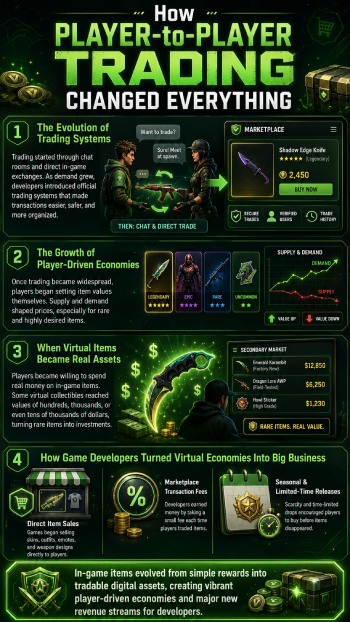
Now, player trading was not always as sophisticated as it is today. There was previously no real organized trading system. Players only do it through chat rooms or direct in-game interactions. But as the trading became more popular, developers had to introduce official trading systems to make these exchanges easier and safer. They introduced some trading features that have now enhanced the interactions between buyers and sellers.
This was a major step forward. Not only did it reduce the risk of scams, but it also encouraged more players to participate in trading.
The Growth of Player-Driven Economies
Once trading became widespread, something even more interesting happened. Players themselves began determining the value of items.
Just like in real-world markets, supply and demand started influencing value. If an item was rare and highly sought after, its value became high because players were often willing to offer significantly more in exchange for it.
As more players participated in trading, things became even more organized and sophisticated. It now became possible for players to browse listings, compare prices, and conduct transactions with a much larger pool of buyers and sellers.
When Virtual Items Became Real Assets
The biggest turning point came when players became willing to spend real money to obtain in-game items. And some items started selling for hundreds of dollars, and others thousands, tens of thousands, and so on.
The buying and selling then grew to a point where they now take place in secondary markets outside the game’s primary marketplace. These platforms gave players additional opportunities to trade items and convert virtual assets into real money. At that point, more players began viewing certain items as investments. And that gave rise to collectors who pursued rare digital possessions. The story of the Blue Gem knife mentioned earlier is perhaps the clearest example of how far things have now come.
How Game Developers Turned Virtual Economies Into Big Business
As mentioned earlier, game developers also got into the action, capitalizing on this newborn business and economy that is now the in-game marketplace. They created a profitable business through things like direct sales of items, market transaction fees, and so on.
- Direct Item Sales: Rather than requiring players to earn every item through gameplay, many games started allowing players to purchase skins, cosmetic items, character outfits, emotes, weapon designs, and other digital content directly from an in-game store. It was a win-win situation, convenient for players and highly profitable for developers.
- Marketplace Transaction Fees: As developers went further by allowing players to trade items with one another through official marketplaces, they also started charging a fee on each transaction. So every time an item changes hands, the platform takes a small percentage of the sale.
- Seasonal Content and Limited-Time Releases: As mentioned earlier, some in-game items were only released on rare occasions. This created excitement and gave players new reasons to spend money. Specifically, because these items may only be available for a short period, players are encouraged to purchase them before the opportunity disappears.
The Challenge of Balancing In-Game Marketplaces
Without a doubt, the business environment and virtual economy that in-game marketplaces have become generate enormous amounts of revenue for developers and players. It also kept players engaged. However, just like real-world economies, virtual economies require careful management. If too many items flood the market, prices can collapse. If valuable items become too difficult to obtain, players may become frustrated. And if unfair practices are allowed to thrive, trust in the marketplace can quickly disappear.
Developers, therefore, had to come up with ways to balance the in-game marketplace. They do this through the following measures:
Preventing Market Inflation
Just like with real money, inflation occurs when too many of an in-game item enter circulation. The perceived value often begins to decline because players no longer see it as rare or desirable. To avoid this problem, developers carefully manage how items are introduced into the game.
Managing Supply and Demand
This is also closely related to inflation. As we’ve already discussed, if an item is highly desirable but only available in limited quantities, demand tends to increase. And if the item becomes too easy to acquire, demand often falls. This is why developers have now started controlling how frequently certain items enter the marketplace, thereby influencing their rarity and perceived value.
The goal is not necessarily to make everything extremely rare, but to create a balance where players feel rewarded for participating while still preserving enough scarcity to keep the marketplace active and meaningful.
Maintaining Fairness for Players
Another major challenge is maintaining fairness. Players generally accept spending money on cosmetic items because these purchases do not usually provide a direct gameplay advantage. But, there are usually problems when players feel that those who spend more money gain an unfair edge over everyone else.
This is where concerns about “pay-to-win” mechanics often emerge. If powerful weapons, abilities, or gameplay advantages can be purchased too easily, many players may view the marketplace as unfair. Over time, this can damage player trust and reduce long-term engagement in the game itself.
As a result, many developers try to strike a balance between monetization and player satisfaction. They want the marketplace to generate revenue, but they also want players to feel that skill, effort, and enjoyment remain at the center of the gaming experience.
Combating Fraud and Market Manipulation
As virtual items become more valuable, they naturally attract bad actors looking to exploit the system. Scams are one of the most common problems. Players may be tricked into unfair trades or persuaded to give away valuable items. In other cases, automated bots may be used to farm items or manipulate marketplace activity. Some individuals may also attempt to exploit glitches, duplicate items, or engage in unauthorized trading practices.
These activities can undermine the integrity of an in-game marketplace and harm legitimate players. For this reason, developers invest heavily in security measures, trade protections, monitoring systems, and anti-fraud tools designed to keep marketplaces safe and trustworthy.
From Simple Purchases to Billion-Dollar Game Economies
The in-game marketplace has become a key part of the modern gaming ecosystem. For players, it has made games more engaging by creating additional activities beyond gameplay itself, including trading, collecting, and participating in marketplace transactions. For some players, these marketplaces have even become a source of income. For game developers, meanwhile, they have evolved into a major revenue stream.
However, the journey to this point has been gradual. In the early days, gaming was largely a straightforward experience: players bought a game, installed it, played it, and occasionally downloaded updates. Over the years, that model has changed dramatically. Today, the gaming ecosystem, and particularly in-game marketplaces, has evolved into a massive digital economy worth billions of dollars, with virtual goods, cosmetic items, battle passes, player-to-player trading, and digital collectibles generating significant revenue for both developers and platform operators.