
Have you ever experienced sitting down to play a game for an hour, only to realize several hours have passed because you were just completely absorbed in the experience? This is one thing that usually happens with open-world games. They are immersive. They have that ability to pull players into the virtual in-game worlds in a way that feels real.
But what exactly makes these games immersive? What is that thing that draws players in and makes their experience feel real?
We will be answering that question in this article. We will examine the different factors that make an open-world game feel immersive, examining factors like the design, storytelling, audio, and so on. Let’s dive right in!
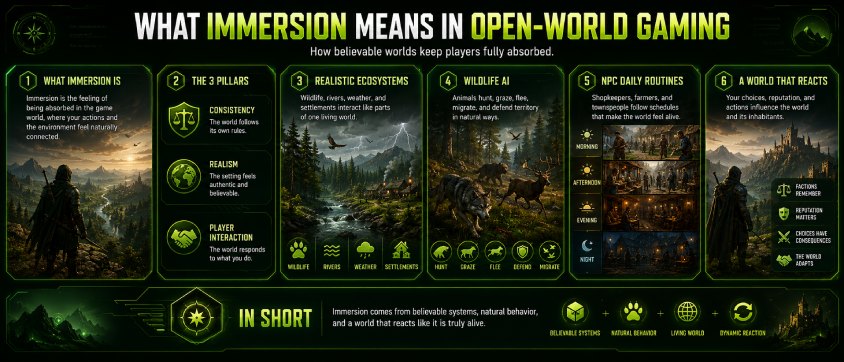
What Immersion Means in Open-World Gaming
In gaming, immersion is simply the psychological state of being absorbed in a game. A game is immersive when there’s a seamless connection between your actions and the virtual in-game environment. That environment feels real, in a way. Even though you know that what you are interacting with does not exist in the real world, immersion makes that awareness fade into the background, and it begins to feel like you are present in the game.
Immersion in gaming is anchored by three primary factors: consistency, realism, and player interaction.
- Consistency: Consistency simply means that the in-game world follows its own rules and behaves in ways that make sense. In a hunting game, for example, if animals suddenly disappear without explanation, or the weather changes randomly without affecting the environment, those incidents are not consistent with what the game is designed to communicate. And so, it stops feeling real.
- Realism: Realism in gaming means that the in-game world feels authentic within the context of its own setting. That is, if you say it’s a survival game, then the features and design of the game must look and feel like that. In a way, it relates to consistency.
- Player interaction: For a game to be immersive, players must be able to interact with the in-game environment. The environment must respond to the player’s action in believable ways.
In-Game Elements Developers Use to Make Open-World Games Feel Immersive
If a game is going to be immersive, a huge part of achieving that rests on the shoulders of the game developers. There are a number of features and designs that the developer puts in place that work together to simulate how a real environment functions. These include:
Realistic Ecosystems and Real World Simulation
Every immersive open-world game has a functioning ecosystem. That is, every part and element in the in-game world interacts in ways that make sense. That is, the elements in the games actually function in the way that they would in a real-life situation.
For example, the forests in a game may contain different species of wildlife. The rivers may provide water for animals and nearby settlements. And the weather conditions would also be able to affect both wildlife behavior and player activities.
The key is that these different elements in the game do not feel disconnected. They work together to create a world that appears natural and believable.
Wildlife AI and Natural Animal Behavior
This also relates to the realistic ecosystem in the game. But this specifically focuses on the behavior of wildlife in the game.
In many modern open-world games today, the animals are no longer just background decorations that the developer places randomly around the map. Instead, these animals are designed to have behaviors and reactions that resemble how real animals act in nature.
Depending on the species, an animal might hunt, graze, migrate, rest, flee from danger, or defend their territory. For example, predators might stalk prey through forests, while herbivores move in groups to reduce their chances of being attacked. Some animals may also become aggressive when threatened, while some will immediately run away when they detect danger. These behaviors help create the impression that the wildlife in the game actually exists.
Also, rather than existing separately, the animals often interact with one another. You might see predators hunting smaller animals, scavengers feeding on remains, or different species competing for resources. All these can happen naturally as you explore the game, and they make the in-game environment feel more authentic.
NPC Activity and Daily World Routines
In less immersive games, the NPCs often stand in the same location indefinitely and repeat the same dialogue regardless of the time of day or events occurring around them. While this is a functional approach, it can make the in-game world feel artificial and lifeless.
Modern open-world games are increasingly avoiding this by giving NPCs routines and schedules. For example, the in-game shopkeeper may open his store in the morning and close it at night. Farmers may work in their fields during the day and return home in the evening. These activities create the impression that people have lives beyond their interactions with the player.
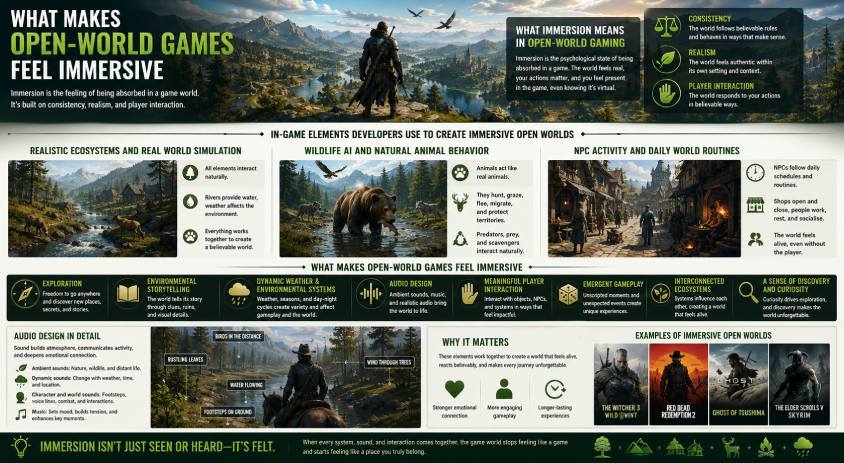
What Makes Open-World Games Feel Immersive
Developers can build realistic ecosystems, intelligent wildlife, and active NPC routines, but immersion goes beyond these individual systems. There are also certain concepts that help tie everything together and make players feel like they are truly part of the game world. These include:
- Exploration
- Environmental storytelling
- Dynamic weather and environmental systems
- Audio design
- Meaningful player interaction
- Emergent gameplay
- Interconnected ecosystems
- A sense of discovery and curiosity
These concepts shape how players explore, interact with, and experience the environment around them.
Exploration
One of the defining features of open-world games is the freedom they give players to explore. And that’s one major thing that drives immersion. Unlike more linear games that guide players through a fixed path, open-world games allow players to decide where to go, what to do, and how they want to experience the world. This freedom makes players feel less like they are following instructions and more like they are living within the game world itself.
But simply giving players a large map and the freedom to explore is not enough. Exploration becomes immersive when it also creates curiosity and constantly presents opportunities for discovery. Players should feel like there is always something worth finding just beyond the next hill, inside the next cave, or hidden within the next forest. This could be a secret location, a rare item, an abandoned settlement, a unique wildlife encounter, or even a piece of the game’s history. These discoveries give players reasons to keep exploring and reward them for paying attention to the world around them.
Environmental Storytelling
Environmental storytelling is the practice of communicating a game’s story, history, and world-building through visual details and environmental design rather than direct narration or dialogue. Environmental storytelling is a major feature in open-world games. Rather than directly telling players what happened, developers of these games allow players to uncover clues and piece together stories on their own.
For example, abandoned settlements like empty villages and damaged homes might suggest that the residents were forced to flee due to war, disease, natural disasters, or some other major event. Battlefields and conflict zones with features like broken weapons, destroyed structures, and remnants of war suggest that a significant conflict once took place there, leaving lasting effects on the surrounding area and its people. And ancient temples, castles, and abandoned facilities might reveal information about the in-game world’s history, culture, beliefs, technological advancement, or the rise and fall of past civilizations.
Because players actively uncover these stories themselves, they often feel more connected to the world and more invested in its history. This sense of discovery even makes exploration more rewarding and encourages players to pay closer attention to their surroundings.
Dynamic Weather and Environmental Systems
Real-world environments are constantly changing, and immersive and open-world games try to recreate that experience through dynamic weather and environmental systems. One of the biggest ways games achieve this is through changing weather conditions. Game developers introduce rain, fog, snow, strong winds, storms, and sunshine to add variety to the game environment and make the world feel less static and predictable.
In many games, the weather is also not just a visual effect. It can directly influence gameplay. For example, heavy rain might reduce visibility and make it harder to spot enemies or landmarks. Snow may slow movement and make travel more challenging. Fog can limit how far players can see, while extreme weather conditions in survival games may require players to find shelter, manage resources, or adapt their strategy to stay alive.
As a result, players often need to approach situations differently depending on the environmental conditions they encounter. A route that is safe and easy to travel during clear weather may become far more dangerous during a storm. This encourages players to think carefully about their decisions and adapt to changing circumstances.
The introduction of day-night cycles also adds another layer of immersion. Many open-world games feature wildlife, NPCs, and activities that change depending on the time of day. Some animals may only appear at night, certain locations may become more dangerous after dark, and NPC routines may shift as people go about their daily lives. These changes make the world feel active even when the player is not directly influencing it.
Audio Design
Graphics may be the first thing players notice, but sound often plays an equally important role in immersion. Without audio, even the most visually impressive game design can feel empty. Sound helps create atmosphere, communicate activity, and strengthen emotional engagement.
Developers use a wide range of audio elements to bring virtual worlds to life. These include:
- Ambient sounds: Birds singing, insects buzzing, rustling leaves, and distant conversations help establish a believable environment. These subtle background sounds make the in-game world feel populated and alive, even when nothing significant is happening nearby.
- Environmental audio: Wind, rain, rivers, waterfalls, ocean waves, and other natural sounds help reinforce the presence of the environment. They create the impression that the world is constantly active and functioning independently of the player.
- Regional soundscapes: Different areas can have unique audio identities that help distinguish one location from another. A busy town might be filled with chatter and activity, while a remote forest may be defined by wildlife sounds and the movement of the wind through the trees.
- Dynamic music: These include music that adapts to exploration, danger, discovery, and emotional moments. They have a way of helping players connect more deeply with the experience. For example, calm music may accompany exploration, while more intense tracks can signal combat or other high-stakes situations.
Together, these audio cues help players understand their surroundings, anticipate events, and feel more connected to the world they are exploring.
Meaningful Player Interaction
An in-game world becomes much more immersive when players can interact with it in meaningful ways. The more responsive the game world is, the easier it becomes for players to feel like their actions matter. So instead of simply observing the environment, they become active participants within it.
Meaningful interaction goes beyond allowing players to press buttons or complete objectives. It involves creating systems that acknowledge player actions and respond to them in believable ways. These include:
- Responsive environments: Objects, wildlife, and characters react to player actions in believable ways. Animals may flee when disturbed, NPCs may respond differently based on player behavior, and environmental elements may change as a result of player interactions.
- Consequences for actions: Decisions can influence quests, characters, factions, and even the broader game world. When choices lead to visible outcomes, players feel a stronger connection to the events unfolding around them.
- Multiple ways to interact: Players may be able to hunt, craft, trade, build relationships, negotiate, explore, or solve problems using different approaches. This flexibility allows players to engage with the world in ways that suit their preferred playstyle.
Emergent Gameplay
Emergent gameplay is a common feature in many open-world games. It occurs when different game systems interact with one another to create unique situations that developers did not specifically script or plan in advance. Rather than following a predetermined sequence of events, these moments emerge naturally from the interactions between the game’s mechanics, environment, NPCs, wildlife, and player actions.
Emergent gameplay usually creates experiences that feel unpredictable and organic. Players are not just following a scripted storyline; they are participating in events that develop dynamically based on what is happening in the world at that moment.
For example, imagine a player traveling through a forest when a pack of wolves begins chasing a deer. The deer runs into a nearby bandit camp, causing the wolves to attack the bandits. As the chaos unfolds, the player takes advantage of the distraction to sneak through the area unnoticed. None of these events was necessarily designed as a specific mission or scripted encounter. Instead, they emerged naturally from the interaction between the wildlife AI, NPC behavior, and the player’s presence.
These kinds of unscripted moments make the in-game world feel more alive because they create the impression that events can happen independently of the player. The game world appears to have its own systems, relationships, and activities constantly unfolding in the background. As a result, every player’s experience can be slightly different, adding to the sense of realism, discovery, and immersion.
A Sense of Discovery and Curiosity
Another factor that makes open-world games immersive is their ability to create a strong sense of discovery and curiosity. Players keep exploring because they believe there is always something new waiting to be found. It could be a hidden location in the mountains, a rare creature roaming a remote area, an unexpected side story, valuable resources, etc.
This constant possibility of finding something interesting encourages players to move beyond the main objectives and explore the world for its own sake. The game becomes less about reaching a destination and more about the journey of uncovering what lies around the next corner.
Part of what drives this curiosity is the excitement of the unknown. Players are naturally drawn toward places they have not yet explored. Unmarked paths, distant landmarks, mysterious structures, and unexplored regions create a sense of wonder that encourages investigation. Players want to know what is over the next hill, or inside the next cave.
Open-world games also reinforce curiosity by rewarding exploration. Hidden treasures, rare items, useful resources, secret quests, unique encounters, and pieces of the game’s lore are often scattered throughout the in-game world. These discoveries make players feel that taking the time to explore was worthwhile and encourage them to keep searching for more.
Why Players Lose Themselves in Open Worlds
Open-world games have a unique way of drawing players in and keeping them engaged for hours. Simply put, they are immersive.
Their realistic graphics and detailed environments actually explain why they have this draw that they have. However, immersion goes much deeper than visual design alone. It is also the combination of other factors, like environmental storytelling, immersive audio, meaningful player interaction, and the countless opportunities for exploration that players have when they play these games.