
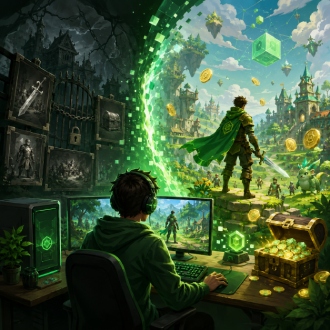
For decades, you paid your money to buy a game, or you downloaded a free-to-play game, and then you invested hundreds of hours into building your own little empire. You unlocked a rare sword, built a huge virtual city, or customized your character until it looked exactly right.
But the moment you clicked “Quit Game” or closed the app, that value instantly disappeared. The time you spent was gone forever, and your rare assets stayed locked behind a wall owned entirely by the publisher. If the company decided to shut down the servers, your hard work disappeared into the thin air of the online world. So, you basically owned nothing.
Arrival of Play-to Earn
Then came Play-to-Earn (P2E) games that changed the game altogether and the idea was quite simple. Play a game, get rewarded, and turn that reward into something real. That was an exciting prospect, particularly for gamers who already spent hours online every day. Unsurprisingly, the idea quickly caught on and became one of the biggest gaming trends of the early 2020s.
Play-to-Earn games brought together gaming, crypto, and digital ownership at exactly the right moment. The idea spread quickly, and stories about players earning serious money helped fuel the excitement. However, keeping those virtual economies alive proved much harder than attracting people to them in the first place.
How virtual items became really valuable
To understand why this change mattered so much, it helps to start with how most video games normally work. In traditional games, everything in the in-game economy is controlled by the developer. They decide what items exist, how rare they are, and how much they’re worth.
Even something “rare” like a special skin or item can be copied and churned out in massive numbers whenever the company wants. Players don’t completely own these items and instead have a limited license to use them in the game’s system.
Play-to-Earn games shook things up by giving players more control over the digital items they collect. Ownership started to feel more real, more like how things work in real markets, rather than everything being locked in one company’s system.
In-Game currencies and tokenomics
P2E games basically utilize native cryptocurrency tokens, instead of traditional high-score points, gold coins, or gems that only exist as lines of code on a private server. These tokens are minted on an open, public blockchain network, which means they have a fixed supply, and they can be transferred completely outside the game.
When you complete a difficult quest, win a competitive match, or defeat a boss, you are rewarded with these tokens. Because they live on an independent blockchain, you can take them out of the game, move them to a public cryptocurrency exchange, and instantly swap them for Bitcoin, Ethereum, or traditional fiat currencies like US Dollars or Euros.
True ownership through NFTs
NFTs made a big difference by giving digital items a unique identity. In normal games, rare items are just copies shared by many players. In Play-to-Earn games, each item can be one-of-a-kind and linked to the player through the blockchain. This means the item can be tracked, owned, and traded more like something real. It also gives players more control over what they own, instead of everything being fully controlled by the game developer.
Open digital marketplaces
So because these digital assets exist independently of the game client itself, players don’t have to rely on shady, unauthorized, and dangerous third-party forums to trade their items. All trades happen on secure, peer-to-peer digital marketplaces.
Players can sell their in-game items on official marketplaces or third-party platforms like OpenSea, setting their own prices based on demand. This creates a real supply-and-demand system for players.
How have the players’ motivation and progression changed?
When a game’s rewards start having real value, the way how people play changes. In most traditional games, progression is built with short-term rewards like leveling up, unlocking achievements, or getting new items that mainly serve as status symbols. These systems are designed to keep players engaged by feeling success.
Play-to-Earn games added a new element to this by introducing financial rewards. Because in-game items and progress could now have real value outside the game, players started to think about their time differently.
In a normal game, a player might spend months working through a battle pass just to unlock a rare outfit or cosmetic item, mostly for fun or bragging rights among friends. In this system, that same kind of progression can also be connected to a value, where in-game rewards represent something that might increase or be traded over time.
| Feature | Traditional Gaming | Play-to-Earn (P2E) |
|---|---|---|
| Asset ownership | Items stay inside the game and are fully controlled by the publisher | Players can truly own items through NFTs and store them in their own wallets |
| Currency value | Only useful inside the game, with no real-world value | Can be traded and sometimes converted into real money |
| Market structure | Closed system controlled by the game developer | Open markets where players can trade directly with each other |
| Player role | Mostly just playing for fun and entertainment | Playing while also participating in trading and earning |
| Server shutdown risk | Progress and items disappear if the game shuts down | Items stay with the player even if the game stops running |
These differences also changed why people log into games every day. It wasn’t just about relaxing after work, because a lot of people started treating it more like a way to earn something, where better decisions could lead to better results. Players began paying attention to how much their time in the game was actually “worth.”
And then, there was a new thing, which is called gaming guilds. These were organized groups that purchased large amounts of expensive NFT assets and lent them to players who could not afford the entry cost. The players utilized the assets, earned tokens by playing and then shared the profits with the guild owners. This setup, for a short time, made gaming feel like a real income opportunity for many people, rather than just a hobby.
When things became chaotic, why did everyone start paying attention?
At the start, Play-to-Earn created almost unbelievable stories. Thousands of regular gamers in nations like the Philippines, Vietnam, and Venezuela were making more money from games like Axie Infinity than they could from legitimate local jobs at the time.
People now have more chances to participate in the global economy because of unexpected events. Due to complex regulations and documentation, many of these gamers in rural locations didn’t even have a typical bank account, but they were still able to use cryptocurrency wallets and earn digital tokens. For many, having a smartphone and a reliable internet connection was all that was needed to sign up for this new system instead of conventional banking access.
For game developers, this model opened up a new way to fund, launch, and support large-scale projects. They weren’t limited to microtransactions, loot boxes, or outside investors that often reduced creative control, so they could sell early in-game assets directly to the community that was already really excited about the game.
This helped align the interests of players and developers more closely. When a game became successful and attracted more players, the early items and assets inside it could also increase in value. In that situation, both the developers building the game and the players who joined early could benefit from how well the game performed over time.
Items that worked across different games
Because these assets exist on open blockchains, different developers could, in theory, build games that use the same items. For example, a rare sword earned in one fantasy game could later be used in another game, like unlocking a special cosmetic in a sci-fi racing game. And of course, this idea made the future of connected digital worlds feel very exciting for many tech lovers.
Some problems with Play-to-Earn
The early success of Play-to-Earn made the model look promising, but that optimism didn’t last forever. As the market cooled down, many projects ran into serious problems. A big issue was that a large number of early Play-to-Earn games were built on economic systems that were difficult to sustain over the long term.
The problem was that many early Play-to-Earn games depended heavily on a constant flow of new players. As long as more people kept joining, the system seemed to work.
- New players often had to buy starter assets, such as virtual creatures or plots of land, before they could begin playing.
- Existing players earned tokens through gameplay and sold them to the new players entering the game.
- In many cases, the tokens had limited practical use beyond creating new assets or upgrading existing ones.
This created a really fragile system that only worked as long as new players kept joining and bringing in fresh money. The moment that slowed down, things started to fall apart, because there were suddenly way more tokens being earned than people actually wanted to buy.
Prices dropped fast, in-game assets lost their value, and the rewards many players were relying on quickly shrank. First, it was an exciting way to earn money through gaming, but then it turned into long hours of play for very small returns.
Why many players pushed back?
Beyond the economic problems, a lot of regular gamers weren’t happy with how Play-to-Earn changed things, which is understandable. Many felt that bringing money into games made them less about fun and more about profit.
The whole atmosphere of games changed as objects began to have actual value. Squeezing out every advantage was now more important than just playing. Additionally, users who simply wanted to enjoy the game found the experience irritating as cheaters, bots, and people attempting to farm money began to appear everywhere.
And early blockchain systems also got a lot of criticism for their environmental impact. They used a huge amount of energy, and transaction fees were often too high for casual use, which made the whole idea feel impractical for many people. Newer networks have improved a lot on this, but the negative reputation has stuck around for quite a while.
Finding a balance way to earn while playing
The excitement with Play-to-Earn eventually started to slow down, and with it came a more realistic view of how these systems actually work. The idea itself didn’t disappear, but it became clear that something had to change. Developers began to understand that a game can’t really hold up in the long run if everyone is only there to take money out of it. For it to feel stable, there also need to be players who are simply there to play, spend a bit, and just enjoy the experience itself.
Putting fun back in the center of gaming
That’s when the idea of “Play-and-Earn” started to take shape. The difference might sound small at first, but it actually changes how the whole system is built.
In Play-and-Earn games, the focus goes back to making something that’s genuinely fun to play. The blockchain features, tokens, and NFTs are still there, but they’re more like an extra. The main goal becomes building a game people enjoy for what it is, where buying skins, battle passes, or expansions feels natural, just like in most big mainstream games today. And this way, money comes into the game naturally from people who just want to play and enjoy it.
How game economies actually work?
To make a game last for years instead of just a few months, developers started looking at them a bit like real-world economies. If money is only constantly created but nothing is being used or “spent” back into the system, things quickly fall apart.
In the early Play-to-Earn systems, inflation got out of hand very quickly. Players were earning huge amounts of tokens every day, but there wasn’t really anything in the game that would take those tokens back out of circulation. Normally, games have ways to “remove” currency from the system, so things stay balanced. Here, that was missing, and because of that, players could mostly just turn their rewards into more ways of earning rewards. Over time, more and more tokens kept piling up, and the value of everything started to drop, basically.
Why spending matters in Play-and-Earn games
Modern Play-and-Earn games try to fix this by adding ways to spend and “use up” tokens. Players don’t just earn and hold them, but they also have to spend or burn them to access certain parts of the game, like special tournaments, character upgrades, player customization, or voting in community decisions.
When players spend tokens on things like skins or visual effects just because they like how they look, it affects their own experience, and it also helps keep the game’s economy more balanced for everyone else.
What Play-to-Earn changed for good?
The Play-to-Earn era left a very visible mark on how we think about digital games and online worlds. It also made it obvious that players don’t just want to be passive users in a system they don’t control. A lot of people care about having more say in how things work, and about actually owning something meaningful in the games they spend time on.
We’re slowly ending up with a mix of old-school and newer systems in gaming. It’s still pretty unlikely that every future game will use crypto or need a digital wallet just to get started. Big studios are careful with this, and a lot of players still just want simple games that work without extra steps.
Even so, digital ownership has shown it can actually work in practice. Some mainstream studios are already trying out in-game marketplaces where players have more freedom to trade their items, instead of everything being fully locked down by the developer.
All in all, the lesson with Play-to-Earn is that digital life keeps getting closer to real life and the value of in-game items isn’t going away anytime soon.