
In 20 years of computer games, there’s been a major change in the concept of ownership. Players used to have the clearly defined sense of ownership of physical game discs and cartridges. You could buy, store, rebuy, redeal and resell the game. It is nothing like this in today’s world of games. Much of the gaming industry today remains based on the digital storefront, the online account, downloadable content, live-service ecosystems, and the cloud.
This development has led to debates which have never come to a resolution regarding ownership of the players’ digital content. Others have said that digital purchases are not really buying a thing, but a licence. Among others are those who think that players are more entitled to the rights of virtual assets they have invested time and money into obtaining. These and more practices have further fueled the debates surrounding blockchain gaming and NFT-based systems.
The Evolution from Physical Games to Digital Ecosystems
Ownership historically used to go hand-in-hand with physical media. Typically, when they bought a game, they bought a cartridge, disc or boxed game on which they had to load to play, in isolation of an online connection.
All that changed with digital distribution. Players could buy and download games for free, based on accounts, from there. That ease, it offered, and that accessibility, but at the same time it took the power to the publishers and platform providers.
Today’s digital games are commonly not only played via an account, but also associated with it. Access is subject to restrictions on software authentication, online access, legal reasons and geographical access. When a business stops operating or an account is suspended, so may the content purchased.
This change as a result was further promoted by the arrival of service-based games.It accelerated when live-service gaming was introduced. In many games, usage has become an evolution process and they are no longer just a standalone game. The player experience is becoming more and more defined by content updates, online verification and progression models for the seasons.
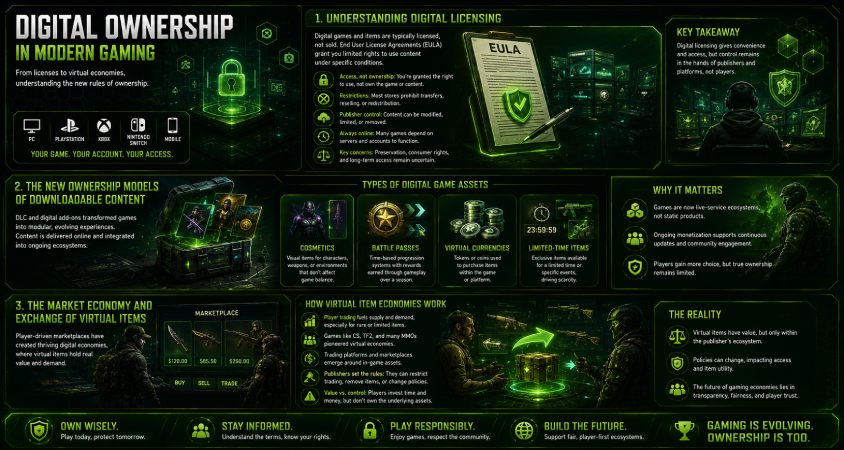
Understanding Digital Licensing
Licenses are one of the central problems in digital game possession. The deals in which players pay for digital games as well as items may not be essentially purchases of exclusive usage rights, but instead are limiting rights in the classical sense.
Digital content is typically licensed through an end user license agreement (EULA), which specifies the conditions of the use of this content. These contracts usually offer access to software with quite a high degree of control remaining with the publishers and platform operators.
The majority of online stores will indicate that they disallow transfers, reselling/redistribution without permission. Publishers may also choose to alter or stop online offerings related to purchased content in many instances.
With this licensing model, as opposed to traditional physical ownership, their potential to impact a broader audience is far greater. Perhaps a physical game doesn’t need to use any publishers’ authentication devices for decades after all. Today’s video games could rely completely on an outer internet host or internet based account system.
These changes have thus posed questions regarding preservation, consumer rights and access to purchased content in the long term.
The New Ownership Models of Downloadable Content
Sometimes known as ‘DLC’, downloadable content was among the first illustrations of changing ownership in gaming. Traditionally, developers distribute standalone add-on games in physical stores but started selling smaller updates online.
In the case of DLC, it could be story expansions, cosmetics, maps, character packs, game mechanics etc. When it comes to live-service games, downloadable content usually doesn’t operate as single, stand-alone expansion offers but are instead considered an integral part of the ongoing profit-making process.
The policy reversed how the owners interacted with their players; games evolved into modular and many of these parts were sold separately.
Today, there are various kinds of digital game assets to drive ownership discussions. These include:
- Cosmetics: Players can apply changes to their character, weapons or environments in a player wearing style that doesn’t alter the balance of the game.
- Stable items that are rewarded in battle periods are directly linked to battle passes, and interact with them via a time-based progression system.
- Virtual currencies introduce a system where players can buy items in the game with tokens from the platform on which they are playing.
- Scarcity is fostered by limited time marketplace items, as they become available for sale for a limited time or in a specific season.
It’s these systems that have morphed games into on-going commercial ecosystems instead of static products.
The Market Economy and Exchange of Virtual Items
Certain multi-player titles enable marketplace systems which allow the individual players to purchase, sell or trade virtual goods. These digital economies can take on a lively existence, especially if the game allows for cosmetics or rarity (collectibles) for its characters.
Player-driven marketplaces created innovation in gaming communities providing models with new economic dynamics. New economic dynamics in gaming communities were created through player-driven marketplaces. Things that are rare and popular or historically significant in a game sometimes turn into very valuable items.
The virtual item economies were popularized through games like Counter-strike, Team fortress 2 and other MMOs. For many, digital asset trading platforms sprung up around these systems, adding to the value of digitized assets.
Within these platforms, however, the rules so far allow restricted copyright usage. Publishers can restrict trading by marketplace, may remove products, and can establish regulations of marketplaces.
This plays to the potential conflict between what the players want and what controls the platform. Users can invest considerable value in obtaining any of these rare digital assets; however, that doesn’t guarantee that they will be able to keep or use them as desired, simply because of publisher policy.
The Discussion Surrounding User-Generated Economies and Digital Labour
Online games that have a strong economy have a large amount of user generated activity. Players develop virtual products (or create in-game trading businesses or goods from adding custom content that can have economic value within the game economy).
MMOGs often have intricate economies in which players can do a lot of crafting, trading, and resource sparring. In certain situations, a player buys and sells a ton of valuable digital property, hours and hours of which can in some cases be earned in the hundreds or thousands!
User-created economies cross the entertainment-AugmentLabour divide. Items created virtually may be very time consuming to obtain and invest in emotionally and economically.
What the following four explorations revealed was that there were several important trends:
- The player marketplaces enable it as a way to really value money by trading activity.
- You may establish a status symbol amongst online gaming neighborhoods with scrumptious digital collectibles.
- Sometimes user-made changes and/or cosmetics can create revenue sharing opportunities.
- Virtual economies build motivation to keep playing with progression and collection.
Secondary trading markets also pose the risk that items may be put up for sale by unauthorized parties, that items are sold at an inflated price, or that the items are the subject of fraud.
The Role of Live-Service Games
The notion of digital ownership underwent considerable change with the development of live-service gaming. February’s announcements for the U.S. launch of Starfield will not result in the final product, but will rather feature ongoing monthly improvements, new game content, and dynamic monetization models.
Digital assets can often be found in environments that are dynamic and constantly changing – live-service environments. Cosmetic codes, inventory and progression codes can change and even disappear.
The pay-as-you-go model typologies are also conducive to the development of recurring sales transactions over single sales transactions. Digital environments see players playing the game on an ongoing basis via battle passes, subscriptions and rotating stores.
This is a good thing and a bad thing. For years, communities can stay active with continuous updates.Update communities can stay active for years, on the other hand. But as players grow more reliant on the publishers’ infrastructure.
Access to purchased digital items could also be completely lost if a live-service game shuts down. This has turned into a great worry, as publishers discontinue the older online publications.
The Ownership Debate and Game Preservation
Discussions on digital ownership are intricately linked with discussions on preservation of games. Past generations of physical games would be able to exist without any central software or service, just in a cartridge, disc or local hardware. Modern computers or PC based systems frequently require the use of servers on web and online authentication.
If they don’t provide their service anymore, games can become illegal even if their players have bought them from a publisher. This is a problem especially with multiplayer games, which can heavily depend on the functioning of servers for their operation etc.
Preservationists believe that the digital game is a cultural artifact and must be able to be played indefinitely after its consumer success. But licensing conditions, and online requirements, can make preservation more difficult.
The added concerns with cloud gaming are, one, that the player might not download local versions of games at all and, two, that the games are stored in the cloud and could be susceptible to malware. Rather, that’s done only via remote streaming that’s managed by the streaming service providers.
All this continues to raise doubts over the security of digital property within the gaming sector.
Blockchain Gaming and Ownership Claims
With the advent of blockchain technology, digital ownership has entered a new dimension. The incentive of blockchain-based games is to allow the players to have decentralised ownership of their in-game assets through tokenisation.
These are some of the claims made by blockchain:
- The tokenised assets are created to be available off the game network or game publishers.
- NFT marketplaces enable marketplace participants to engage in digital asset trading that is independent from the conventional gaming space.
- Blockchain transactions log offers a clear history of digital collectibles transactions.
- The idea of decentralised ownership models is to minimize virtual asset publisher control to some extent.
- Blockchains are often touted to be compatible with assets on other platforms in the future.
While such claims have been made, blockchain gaming has significant controversy from the larger gaming community.
Criticism of the Models of Blockchain Ownership
It’s not so much that many critics say blockchain systems don’t solve the problems they claim to solve as they don’t solve them entirely. Even if the blockchains could be a confirmation, the functional value of digital assets remains an outcome of the game builders backing and taking part in working environments.
If the game gets shut down or if support for the NFT is dropped, the game actually becomes technically impossible for that player to play.If the game closes down or stops supporting the NFT, that will essentially mean that the game will no longer be playable in practice for that player.
Fears have also been voiced by those about the dangers of speculation and financialisation in gaming communities. Some blockchain projects instigated investment-related practices instead of engagement in the usual fashion.
Other blockchains often generated resistance due to environmental issues especially when it comes to energy consumption, as in the initial stages of the adoption of cryptocurrencies.
Moreover, many thought that monetising blockchain was just an extension of existing microtransaction platforms, not a worthwhile reconfiguration of the ownership rights.
This has kept blockchain game adoption in check despite the many marketing messages to date about digital ownership.
Consumer Expectations and Player Rights
Today, buyers are much more likely to demand transparency when making digital purchases. Regulating access, limitations and yesterday-to-tomorrow guarantees on content are becoming a critical consumer concern as the world of online gaming moves toward becoming a more commercial environment.
Consumer advocates say there needs to be better legal protections through digital purchases. Changes recommended are better refund policies, easier owner listings and creating policies to save games that are no longer played.
Others think some sort of ‘transference/resale rights’ should apply to ownership of digital products as well as physical products. But publishers are not always ready to jump on the bandwagon as the digital licensing offers them greater control over distribution and monetisation.
One of the main issues in today’s economies is whether the companies or the players have control over these games.
The Economic Value and Growth of Digital Assets
Digital assets are a significant portion of the financial framework of the games. The global cosmetic marketplaces revenue is in billions of dollars with microtransactions at games bringing in billions, downloadable content bringing in billions and virtual economies bringing in billions.
Nowadays, for many publishers digital content is a bigger share in income than gaming sales. The role of the ownership systems is clearly one that is meant to be impacted by this economic change.
Scarcity offers an incentive for continued spending in multiplayer environments, as does having an item shop that rotates over time, with certain items showing up only at specific moments. An item shop rotation, limited-time events, and scarcity models are all ways to keep people engaged in spending money in the multiplayer environment. Digital ownership, thus, becomes much more than a technological problem; it’s a business strategy.
The Future of Digital Ownership in Gaming
Modern gaming could see further erosion of local ownership as it takes ownership itself over streaming services. However, there could also be greater transparency and an enhancement of the preservation standards as a result of consumer demand.
Ownership expectations may change also due to the cross-platform ecosystem platform. Players want a progression system, purchases and inventories to be available across devices and platforms.
While many of the existing applications of blockchain might continue to be controversial, the technology itself can reach across ownership issues. There may be more interoperability and decentralised identity concepts in the future.
However, no matter how the technology works, discussions about digital ownership stand to remain relevant, as games are becoming ever more intermeshed in the larger digital economies and online social networks.