
Multiplayer games have evolved quite drastically in the last 20 years. There was previously a divide between online games on PC, console and now mobile devices, where one player would only be able to interact with other players using the same platform. The restrictions in their nature influenced not only the development of gaming communities but also how competitive scenes evolved and the organization of the gaming publishers’ online services. If the player was a console user, he or she was probably a different ecosystem altogether compared to the user playing the same game on a PC.
That was until the advent of cross-platform gambling. As networks grew more stable and online-based apps got more advanced, enabling gamers across various devices to interact in the same game online. After initially going along as a kind of small test, it would eventually go on to become one of the biggest, most significant alterations in the gaming scene.
The majority of big multiplayer games have the ability to be synced today. This usability change allows people to play on consoles, PCs, tablets and smartphones in the same game, chat in the same community and play the same active events. The integration has revolutionized matchmaking functionality, social interactions, esports communities and player retention strategies. Cross-platform obviously isn’t something they simply added as a side cap, but rather it has evolved into a core component of the functioning of today’s multiplayer communities.
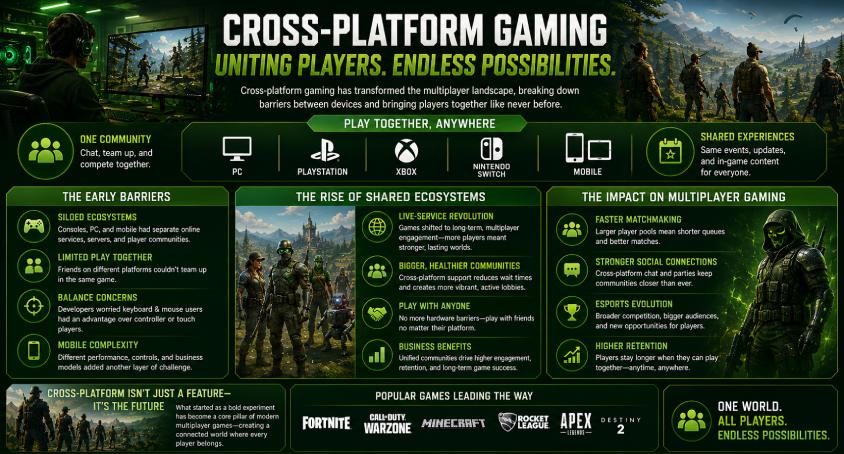
The Early Barriers Between Gaming Platforms
Multiplayer gaming ecosystems have been siloed for many years. The game infrastructure differed for consoles and PCs, with the former using distinct online services and the latter mostly relying on independent online services and servers. The basic concept of mobile gaming came subsequently, with its own audience and revenue streams.
For the games played on online multiplayer platforms in the past, only matches were matched within the same hardware domain. It was often hard for friends to play together on different devices, especially if they don’t play the same game.
Issues of skills balance also came up. Developers had feared that key and mouse users may have an edge over console/advance play along in using their controls. Mobile platforms added dimension into it due to holding screens and different device performance.
But these challenges were overcome by increasing demand for connected online experiences which eventually led to the wider integration of the industry.
The Rise of Shared Multiplayer Ecosystems
The advent of live-service gaming is among the key drivers of cross-platform support. The shift towards longer-term, multiplayer engagement over one-order-of-magnitude shorter single-player experiences. Developers increasingly want to pay attention to longer-term, multiplayer interaction instead of what roughly is one order of magnitude shorter, single player experiences.
Games that incorporated them based on the persistent online communities had larger numbers of players. Platforms were integrated for users to interact, which helped shorten matchmaking times, and allowed for larger, more long-lasting user communities.
Openness also was enhanced by this cross-platform system. No more the need for all the friends to have the same hardware in order to play together. This endeavored to ease a few of the sociological obstructions among the game communities.
This meant that some multiplayer games were able to prove the business benefits of cross-platforming and porting. Unified communities were not only found to be a positive attribute from employee participation, but were also proven to be a vital component for large scale games that have millions of players engaging concurrently.
Cross-Platform (X-Plat) gaming slowly became a norm to many multiplayer games.
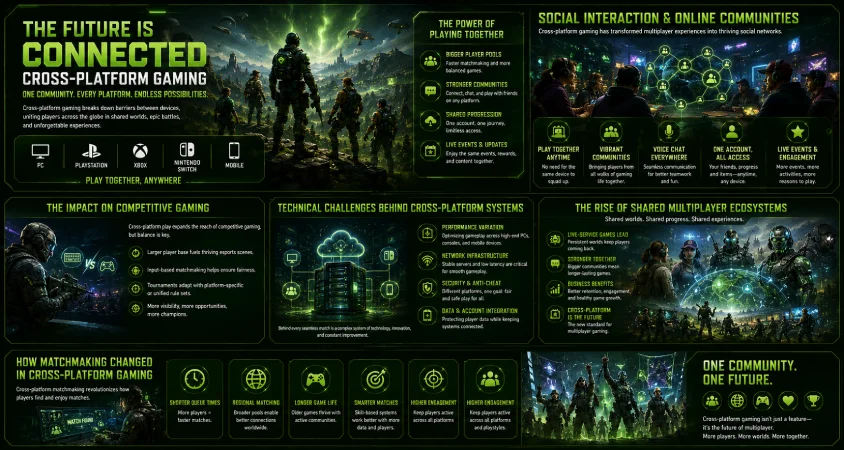
How Matchmaking Changed in Cross-Platform Gaming
The earliest impact of going multi-platform was revamp of the matchmaking operating systems. There was a very limited number of players in multiplayer games, because they were player-centric games.Traditional multiplayer games used to have a small number of players due to their nature being player-centric. This sometimes meant queuing to a long extent, particularly in non-urban areas or outside times.
The cross-platform matchmaking was a pivotal development, giving players a huge increase in the number of players available. Matches could be made more efficiently with games as the matchmaking system would have a more active user population with which to match.
This transition enabled multiplayer stability in several ways:
- In both competitive and casual matchmaking, larger players reduced matchmaking times.
- Games were able to recruit players across various hardware ecosystems, thus facilitating regional matchmaking.
- Older multi-player games, on the other hand, were able to have communities for longer thanks to wider availability of players.
- Skill-based matchmaking systems were able to access more comprehensive resources and match-up better.
- Players could stay engaged in the game’s multiplayer options as it would be easy to keep people actively involved across all platforms.
The outcome was a more stable and balanced gaming experience for both online and offline players, allowing for more bothersome multiplayer.
Cross-Platform Gaming and Player Retention
Player retention is one of the most important concerns Modern Multiplayer Gaming. The selling process is not all about a quick hit because live-service games rely on long games.
Cross platform systems help in the retention of players as it eliminates all the friction in-between. Players having more than one can still play together, even upgrading their devices over time.
This is particularly advantageous when hardware changes. Cross platform ecosystems ensure that communities stay connected, rather than divided among the well-established and newer systems of this generation when a new generation of consoles becomes available.
Additionally, the elements of cross-progression systems have further boosted retention strategies. Numerous games offer player accounts, purchase and progression to transfer from one device to another. Players can start a game on a console and then switch to PC or mobile devices and the character continues their play.
This is enough to make game players stay in a game longer, and enhance the accessibility of the game in different scenes.
The Expansion of Mobile Integration
Mobile gaming ushered in another large paradigm shift with multiplayer.With multiplayer, mobile gaming brought another big revolution to multiplayer ecosystems. Smartphones have increased the accessibility of playing games to audiences who wouldn’t play video games on a console or PC.
Publisher budgets have grown more generous with color and size, as mobile devices began producing movie-quality graphics, but mobile hardware is still building larger multiplayer environments and integrating them into more wide-ranging multiplayer games. Some games were launched with partly or fully shared environments in both mobile and non-mobile versions, with others based on the concept of partially shared environments.
This growth greatly grew the multiplayer communities. The ease with which people could be mobile enabled meant that they could be included more easily and more regularly during the day.
But an issue with mobile integration was also introduced: balancing. The touchscreen controls are very different from traditional controllers and keyboards. The development would frequently have to make changes to the matchmaking mechanics, aiming assist technology and competitive frameworks to ensure a level playing area.
Mobile integration managed to normalise, to some extent, the notion of multiplayer communities moving beyond individual hardware systems.
Social Interaction and Online Communities
Modern gaming changed the way players interact online, as cross-platform games became the standard for internet gaming interaction. In older multiplayer systems, friends typically were segregated according to the device each person owned. These divisions were diminished by shared gaming environments and increased socially.
More and more multiplayer titles are essentially more of a social network instead of just a competitive game. Players can keep communicating in friendly groups and guilds, and can also participate in live events via voice channel from their gamer phones.
On-line identity systems were also bolstered by its cross-platform support. With unified accounts, players can play with the same friends, progress and cosmetic inventory, anywhere.
There were a number of social changes that followed with this shift:
- There is no longer a need for identical equipment for friend groups to play together in multiplayer sessions.
- Online communities can help facilitate greater interaction among players from a diverse range of backgrounds in the videogame world.
- Cross platform voice communication enables better coordination for cooperating and competing.
- One account systems make it easy to connect to social media from various devices.
- More community engagement leads to seasonal live events and online activities, which are more active.
These developments constituted the beginning of the evolution of multi-player games into a more connected social area.
The Impact on Competitive Gaming
The integration of cross-platform has been unsteady with competitive gaming. On the other hand, these advantages drive down costs and increase the visibility and accessibility of competitive games.With greater player numbers, matchmaking can be optimized and esports communities thrive and grow. However balance issues may arise if there are hardware differences.
Typically, the keyboard/mouse controls are more precise, and keyboard/mouse has a lower latency rate, with higher frames per second being available for the PC. The console gamers can opt for systems designed to help them aim when it comes to computerized effects. Mobile Delivery devices present entirely various control schemes.
These differences often lead to a competitive division being based on input technologies, not hardware. A few matchmaking systems cluster controller players over against the keyboard and mouse users.
Organising bodies for esports have also taken different strategies to help keep their games alive. There are some tournaments that even have competitions for platform based, or there are some tournaments that have platform based competitions but under a standardised platform.
Despite the lack of support outside of one particular platform, cross-platform gaming has grown competitive gaming communities, reducing the barriers of entry and extending player numbers longer.
Technical Challenges Behind Cross-Platform Systems
The coordination needed for ‘cross platform games’ is quite extensive. When getting gameplay to sync up amongst diverse hardware architectures, running different operating systems and a variety of network conditions, there are some complicated things that could go wrong.
Application developers need to cater for the large range in performance capabilities across different devices. An elegant video gaming pc can be a lot more able to ship the visual information much compared to an older console or even a smartphone. In games like these, optimization is crucial to ensuring a fair game.
Network infrastructure also comes into much play. To support large distributed-multipayer interactions a stable server architecture is essential to the cross-platform systems.
Security complicates things. All the platforms have different systems for accounts, moderation and anti-cheat technologies. Players’ data must be protected and suitably safeguarded to counter instances of player exploitation, while such systems must be coordinated with developers.
Even with all these challenges, large scale cross-platform systems are becoming much more reliable due to advancements in cloud systems and networking in the online world.
The Role of Publishers and Platform Holders
To support Cross Platform Gaming, cooperation between levels of companies has been needed that have and even ever competed with each other. As mentioned before, console manufacturers have traditionally focussed on developing exclusive home-grown ecosystems that keep users within their system.
As time went on, people acquired their own shoes and began expecting the market to give them what they wanted. Cross-platform support came to be seen by the players as more of a consumer convenience feature than a technical advantage.
Publishers were also aware of the economic benefits from communities that were all in one place. Where a product has a greater in-game purchase volume, it can guarantee that it is more engaging and popular, and that it can also deliver a longer product lifecycle by receiving support from larger multiplayer ecosystems.
This commercial impetus led to a relaxation of some platform owner restrictions on online platforms. Shared account systems, and the inclusion of multiplayer support into major games, started to become a thing, one that would grow more common overall in the future.
Nowadays, cross-platform support is a competitive advantage that should be taken into account when launching a major multiplayer title.
Live-Service Games and Persistent Communities
Also on the ascendant was live-service gaming, which catalysed the development of trans-platform adoption. Running seasonal content games is reliant on strong long-term communities.
Cross-platform ecosystems help to minimize fragmentation to keep these communities. Rather than spawning out among hardware classes, developers could focus their efforts in centralized online spaces.
Player numbers stay concentrated and it’s easier to achieve seasonal updates, battle passes, and live events. As more people are engaged at once, so does the level of social engagement.The more people who are engaged the more is social engagement.
Cultivation of online communities is encouraging investment for as long as possible among players. Better retention in live-service environments is achieved through cosmetic collections, progression systems, social relationships, and others.
The integration with cross platforms has as such started to become intertwined with the more overarching development of modern multiplayer business models.
Accessibility and Inclusivity in Multiplayer Gaming
Cross-platform gaming has added to the convenience of many players, as well. It is possible hardware components might block participation specifically, in competitive online games.
Allowing multiplayer to interact through devices will provide more interactivity options for players. There are those who for simplicity like to love their consoles, and then there are those who have a PC or mobile option because it’s convenient, or because they simply can’t get their hands on certain consoles in their countries.
Other solutions include cross-platform systems, and accessibility ones have also been increased. There are many multiplayer games that allow setting their controls, adapt to different hardware profiles, and set up performance levels as desired.
These transformations contribute to the growing online community and diversifying it. The diversity of possible player backgrounds, skill levels and technical access points is larger and larger in multiplayer gaming these days.
The Future of Cross-Platform Multiplayer
As cloud gaming is a trend that is set to keep growing, mobile devices become even better, and server speeds increase, cross-platform games will continue to grow. The distinctions among video games seem to have long since vanished.
Eventually hardware might be phased out even further with a cloud-based system, as games run from the cloud and streamed to various devices.
There will also be an increase in cross-platform progression systems. Users are becoming more demanding of smooth and hassle-free access to any account, content or social media from one device to the next.
AI can enhance matchmaking by analysing the human tactics while combating imbalance in multiplayer environments.AI can optimize matchmaking in multiplayer environments to achieve balance and learn from player behaviour in wider ecosystems.
Platform identity is likely to become unimportant as multiplayer communities continue to expand, with common access to and connectivity among them becoming more important.